Sunday, July 19, 2015

Manner of Death and Means of Murder


Lone Star Tick Image from
dailynewsdig.com

“Death by misadventure,” a phrase describing manner of death catches my ear and stimulates my imagination. “Unintended consequences” does too. Both spring from the concept of “accident” but imply some sort of human intent, though not necessarily “good” intent or “well considered” intent.

The idea of someone meriting a Darwin Award by bumbling into their own death does not make for a good murder mystery, in my opinion. However, if a third party bumbles into someone’s death while that third party is involved in some nefarious activity – now I’m interested. Or if the dead person colluded in the crime. Or some other crime.

If the dead person were an innocent, and the murderer a jealous lover or crooked business partner or a crazed serial killer, the story very well may not be a mystery at all, but a news story. And those stories can and do inspire murder mystery writers.

All murder mystery writers understand that the most dangerous animal in the woods is homo sapiens sapiens – modern humans. Naturally, the fact that most murder mystery readers are modern humans makes them inordinately interested in what their confreres do or have done to them.

As to “means of murder.”

Agatha Christie was particularly fond of poison. Check out the Agatha Christie section of Torre Abbey Gardens in her hometown of Torquey, England. (May have to add Torquey to my Bucket List.) John LesCroart’s The First Law uses guns – up to and including a major shoot-out. (Maybe I should put San Francisco on the Bucket List.) Nevada Barr in Ill Wind takes advantage of a geologic peculiarity. (Definitely should put Mesa Verde on the ole Bucket List. It’s a lot closer to my house.)

My husband’s education and a lot of his professional experience is in the field of Veterinary Medicine. He says “The most dangerous animal in the woods, after man, is the tick.” Just imagine a man with a tick.

What an intriguing thought. Ticks, as described in Wikipedia, will make your blood run cold and reach for the DEET. And that’s just reading about them.

They have eight legs like their arachnid relatives, spiders and mites. They meet all their nutritional needs by sucking blood. They can carry disease-causing bacteria, viruses, and protozoa. Indeed, they can carry more than one pathogen at the same time making diagnosis and treatment more difficult.

In far southeast Arkansas, where we had a veterinary clinic, my husband provided blood samples from our patients with ehrlichiosis to Dr. Sidney Ewing at Oklahoma State University School of Veterinary Medicine. Ehrlichiosis is caused by members of the genus Ehrlichia, a genus of bacteria named for the German microbiologist Paul Ehrlich. One of those little beasties is Ehrlichia Ewingii, named for OSU's Dr. Ewing. (Rather a perverse honor, I think – having a disease causing agent named for you.)

Ehrlichiosis in dogs and humans has long been successfully treated with Doxycycline but some of our cases were proving to be drug resistant. And untreated or unsuccessfully treated, the disease is lethal.

The important thing in treating any tick-borne disease is beginning treatment immediately which requires early diagnosis or at least awareness that the sufferer has been exposed to a tick so treatment can be started. 

Just think, if the intended victim had not been in the woods – maybe did not even live in an area known to be a tick-bite risk area . . . .

The murderer could acquire the ticks elsewhere. Overnight by UPS then give the little buggers easy access to a blood source to keep them alive – say a mouse the murderer is not particularly fond of. And then access to the victim -- say in the hair behind the ear.


The local medics wouldn’t know to ask about recent tick bites or look for ehrlichia or promptly start proper treatment. Voila – Murder by Tick.

Monday, July 13, 2015

Green Mountain -- a travelogue


My Green Mountain.

That’s how I always refer to it. It’s two miles from our house, but it’s recognizable from almost any place in the Denver area because unlike the rest of the foothills it has a bald, rounded top. So whether I’m at the Museum of Nature and Science down in Denver or the Woodcraft store south of Denver in the town of Centennial, I know which way is home.

This picture was taken May 10, 2015, Mother’s Day. That was our last snow of the 2014-15 winter season. In this picture, weather is coming out of the mountains, obscuring the taller foothills behind Green Mountain and the Front Range 14ers behind them.

We moved to Denver almost four years ago from Edmond, Oklahoma. I had never been interested in exercise or hiking. In Oklahoma if you can't get there in a car, why go? The weather there is not conducive to outdoor activities in the summer -- too hot. Or the winter -- too cold. And there are few sidewalks or walking or biking trails in or near urban areas. They're changing though.

In Lakewood, which is our town, there are bike lanes and sidewalks and trails in the parks and open spaces. Green Mountain is in William F. Hayden Park.

Denver is located at altitude 5,280 feet. Our house is at 5,700 feet and Green Mountain’s summit is at 6,854 feet.

I’ve hiked to Green Mountain's summit and I’ve walked its shoulders in every season. It’s always beautiful – sometimes white with snow, sometimes brown and brittle. This spring and summer it fits its name, green.

                      
           This is my favorite starting point the Utah                   This is my daughter Grace 
           Street Trail Head. No motorized vehicles                     heading west up the trail. In 
           are allowed on the trails, but bicycles are                     that direction, as you can see,           welcome as are horses and hikers.                                the sky was a brilliant blue.                    

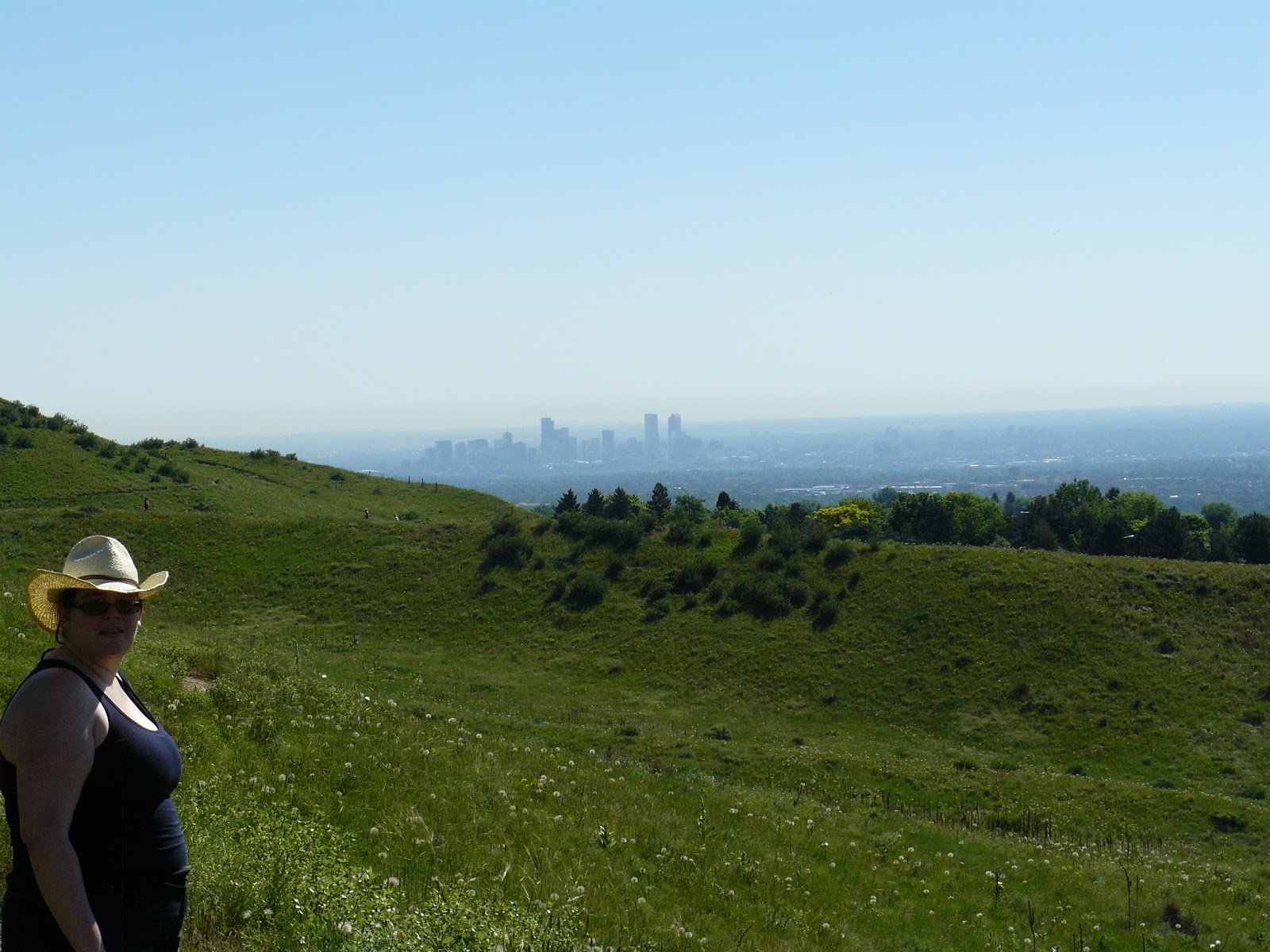
But looking northeast, out across the prairie that day, the haze almost completely obscured Denver.

Weather here is peculiarly local. Looking more to the east, back toward our neighborhood, you can almost see where the haze begins.


          A month after the last snow of the season, wildflowers are peaking on Green Mountain.
                                        Canadian Thistle                                Mariposa Lily  


                                  Orange Paint Brush                               Plains Larkspur

    
                                         Prickly Poppy                                  Saffron Ragwort


Yucca, also called Spanish Bayonet
After an hour on the mountain, I'm ready to head home and get ready for my exercise class. Not only do we have beautiful places to hike, but Lakewood has five rec centers with excellent facilities and staffs. 

           It's good to top the last ridge and be back where we began, Utah Street Trail Head.


Sunday, July 12, 2015

Gone Girl -- A Book Review


This blog post was written July 8 in the foothills of the Front Range of the Rocky Mountains. It should have been hot and dry. It was not. The temperature was 60 degrees and it rained. Not typical Denver-heavy-mist rain, but legitimate drops that made pattering noises on the roof and splashed into the birds’ water bowl.

I should have been working. Novel number two was sitting in my head and languishing on a memory card, waiting for me. There was a piece of short fiction parked on my laptop wanting finishing. I’d committed to writing at least one tweet a day.

And, if that weren’t enough, there was laundry to be done. Instead of doing any of that, I read.

Gone Girl by Gillian Flynn, published June 2012. Wikipedia says it is a “thriller” and “an example of the literary subgenre called Domestic Noir.” A term that was first applied to fiction in 2013 by Julia Crouch, an author described as “the queen of domestic noir.” She defines it as “a broadly feminist view that the domestic sphere is a challenging and sometimes dangerous prospect for its inhabitants.”

The same view of hearth and home held by many street cops, male and female. Retired New York City policeman, Steve Osborne, in his nonfiction TheJob: True Tales from the Life of a New York City Cop, recounts one of many domestic violence cases he's worked. “The wife explained that she was having a heated argument with her beloved, and sisters being sisters – especially in the heat of battle – they stuck together. And when the second woman butted in, the husband went ape shit. . . . he grabbed a large kitchen knife from the sink and carved the two of them up.”

I know I’ve said before that thrillers are not my cup of Earl Grey. And they’re not. Nor do I pay any attention to the New York Times Best Sellers list. But I do take recommendations from friends and family seriously and my daughter said Gone Girl would be interesting to me because of its construction. She was right.

It begins with a husband coming home to discover his wife missing. The story then unfolds alternately, through his viewpoint and the wife’s diary entries. Is she alive? Or dead? Did he do it? If she is alive, how long will she survive?

The plot is exquisitely crafted leaving the reader not knowing what or whom to believe. Twists and turns hardly describe the hairpin curves and backtracks we’re led through. The fear factor, rather than proceeding up and down like a roller coaster, drops us from one frightening crest only a little way down before jerking us to the next greater height. Again and again. Never letting us relax.


I won’t tell you how it ends, but I will say it’ll make you grateful for your own problems.

Friday, July 10, 2015

The Cover Letter


“He’s a nice man,” my husband said.

I know, I thought. I can’t do that. He’s a busy man. Not to mention that I’m more than a little star-struck by him.

“Go ahead. Send him your book. He might like it.”

How cool would that be?!

My chest felt a sudden crushing sensation. You know, like right at the top of the first peak on the roller coaster. The last few seconds before liftoff. That feeling that something awful might happen.

“Write a cover letter and send it to him,” he said.

A cover letter. Of course. I was not at the brink yet. I would compose the perfect cover letter and mail Murder on Ceres to Neil deGrasse Tyson. He’s an astrophysicist. He can see that humanity’s future lies off-Earth. He knows we’ll still be humans and, with or without flying cars, he knows that the future will be normal for those humans who inhabit it. It will be different from today, but it will be just as normal to them as yesterday’s future is normal to us. He’ll get what I tried to do in my
sci-fi/murder mystery.

It could take days. That cover letter. Weeks, maybe.

I began the next day. “Dear Dr. Tyson.” The honorific Dr. is used only for medical doctors except in the South? I’ve been told. And how many times have I been told that all things Southern are somehow less-than? I think of my poetry teacher in college – Dr. Norman Russell, who was a botanist of the first order. A well-respected scientist AND poet who was originally from West Virginia and I’m originally from Oklahoma. Both states are definitely south of New York where Dr. Tyson is from. But Mr. wasn’t right for Dr. Russell and it didn’t feel right for Neil deGrasse Tyson so I kept the honorific.

I then proceeded to write what amounted to little more than a fan letter, telling Dr. Tyson how much I admire him and his work. That I never took issue with his stance on Pluto. That his Cosmos was great and that I was much relieved to hear him say such nice things about Carl Sagan. That I was impressed that he wrote essays for Natural History magazine home of another of my heroes Stephen Jay Gould. That he has a wonderful sense of humor like so many scientists do – Stephen Hawking being an excellent example.

I did show admirable restraint and didn’t mention that I think he’s hot.

I hardly mentioned my book at all.

My editor (who happens to be my daughter) and her friend kindly read my letter and suggested changes.

The letter morphed into a sensible communication that explains a little about Murder on Ceres and why he might enjoy reading it.

Murder on Ceres is an old-fashioned murder mystery set in the future. The story
itself follows intelligent, by-the-book Police Detective Rafael Sirocco, as he tries
to balance the demands of his job and his responsibilities to his family. Through a whirlwind of illicit drugs, space pirates, and secret identities, Rafe chases the truth
all 270,000,000 kilometers from the shining cylinder of Ceres Colony to the alien landscapes of Earth.
And a more reasoned description of my admiration for him.
I appreciate your treating science as “normal” and humanity’s future in Space
as inevitable. I am a great admirer of your work. I think you share my lifelong
passion for space travel and a faith in our future as a species. I hope you enjoy
Murder on Ceres.
Very truly yours,

I signed the letter, ate two left-over muffins, had another cup of coffee, headed to the post office.
I was going to lunch with a friend so I had on make-up and was wearing a dress. Did I mention that I was trembling as I handed THE ENVELOPE to the young woman behind the counter in the post office?
“Have a nice day,” she said.
“You have a nice day, too,” I said.
Then she said, “You look very pretty today. That’s a good color for you.”
Oh, my. Do you think that’s a good omen? Can I be forgiven a small slip of superstition?
I was over the first peak on the roller coaster. Free-falling. Murder on Ceres and its cover letter were away. Flying. That crushing feeling was replaced by exhilaration and I left the post office with one of those nonsensical grins that you just can’t contain.

I did it!

Thursday, June 25, 2015

Phobias -- Flash Fiction


“Greg, don’t go alone,” Dr. Porter said.

She’s a nice woman, well-intentioned, but hard, hard, hard. And pushy. We identified my severest phobia and used exposure therapy to treat it.

We had many to choose from – agoraphobia, the fear of crowds or open spaces, I was afraid of crowds but not open spaces. I don’t know how I missed that one. Ophidiophobia, the fear of snakes, that’s not a severe problem. All I have to do is avoid the herpetarium at the zoo and my Uncle Matt’s house. How anyone can consider a snake as a pet, I’ll never understand.

Caligynephobia, the fear of beautiful women. It’s not that I think they’ll kill me and eat me like a snake really might. But I can’t talk to them. I can’t think. I can’t breathe around them. I know that’s a dumb phobia for a man to have. But are there any sensible phobias?

With Dr. Porter’s help I chose my worst demon to work on first. Acrophobia or altophobia is the fear of heights.

Those exterior elevators? I’d stand facing the interior wall, trying to ignore the rattle and shake as
they carried me to my doom. My co-workers in their business suits and shiny shoes would ooh and ahh at the vistas. I prayed for deliverance and hoped they didn’t notice.

And who can afford seats on the main floor at the symphony? I can’t remember how many times I’ve had to practically crawl on all fours to get up to balcony seats with a date. Actually, I can remember every single time with every single woman. None, of course, very beautiful, but mostly nice.

Seats at the top of stadiums? Indoors? Free tickets for basketball games? Forget about it. The court looked postage-stamp size under spot lights. A black hole threatening to suck me down past the writhing, screaming humans – Albrecht Durer hell, Twenty-first Century style.

Dr. Porter estimated it would take six months to see significant progress.

“Greg,” she said. “Let’s start small.”

Yes, let’s, I thought.

She had me climbing open stairwells. I stood on first floor balconies. Second story balconies. I crossed walk-ways six flights up in atriums. Or is that atria? Whatever. All in downtown Denver.

It may be The Mile High City, but the city itself never gave me a problem. Denver’s out on the prairie east of the Rocky Mountains. A nice city on level ground. No sense of altitude at all.

During that six months I also, at the good doctor’s urging, hiked with my buddy Steve. Mostly in metro-Denver’s open spaces. Some near the base of the foothills. Some within sight of Fourteeners.

Summiting Green Mountain was the goal that Saturday morning. Identified as a mesa southwest of Denver, Wikipedia puts Green Mountain’s altitude at 6,854 feet, almost seventeen hundred feet above the Mile High City.

The parking lot and trail head were part way up the mesa. Signs posted at the entry to the trail warned of possible dangers. Beneath what looked like a wild-west wanted poster of a coyote I read Coyotes are active in this area. The sign said to keep children and dogs under close supervision. Another warned Mountain Lions are active in this area and gave some information in avoiding them.

For some reason coyotes and mountain lions didn’t seem like real threats. For one thing it was 8:30 in the morning and those animals, as I understood it, were nocturnal in their activities. Or at least mostly active at dusk and dawn.

But a third sign hit me like a slap in the face. Rattlesnakes are active . . . . I couldn’t see the rest of the sign.

“Snakes are more afraid of us as than we are of them.” Steve said. I wanted to believe him.

Green Mountain’s trails are well used by the public – hikers, old and young, some carrying infants in back packs, many with dogs on leashes; bicycle riders, also old and young; and people on horseback. Motorized vehicles were not allowed on the trails.

At the first turn, I looked back toward Denver. A spasm shot through my chest. The city of Denver huddled in a haze far out on the plains and farther below me than I’d ever imagined possible. I'd never been so high up outside. Not cocooned in a car or a train or an airplane. When I flew I sat on the aisle and read a book or a magazine. The safety instruction card. Something. Anything. From take-off to landing. I never saw the Earth from a plane.

On Green Mountain, I quickly learned not to look downhill. And not to think about how I’d get back down.

I learned to step off the trail to let others pass. It made sense to me to step off uphill so if I fell, I’d fall up. Falling down that hill could go a long way.

A bird trilled. “That’s a meadow lark,” Steve said.

It was almost as hard to look up the hill to the sky. Where we were going. That much higher. I watched where I put my feet. Rocks pocked the trail, some as big as your fist, half buried in the packed earth. Grasses and wild flowers grew knee high or higher on either side.

“Mariposa lily and yucca.” He pointed at first one flower then another. “Hear that? Frogs. May was so wet, we have frogs.” Steve’s enthusiasm calmed my fear.

I did hear the frogs and the rasping sound of a grasshopper fleeing up the trail ahead of me.

I didn’t hear a cyclist until he was almost on me. Without thinking, I stepped off the trail. Downhill.

“Sorry,” the cyclist called over his shoulder as he passed me, hurtling down the mountain.

I grabbed handfuls of some plant topped with purple flowers to keep from losing my balance. The flowers were fluffy. The leaves and stems were not. It was like grabbing blades, knife blades. But if I let go I’d fall. Two feet of down-sloping terrain and those killer plants stood between me and the trail.

Then I heard it. To my left. Like dry leaves rustling. No, not rustling. Rattling.

“Snake!” I screamed and spun away from the noise. I stepped off the hill into empty space.

Unlike the cartoon coyote, I was not suspended in midair. I dropped like a dead weight, landing on my feet. Pain flashed up my legs from my heels into my spine. Then I was running as fast as I could trying to keep my feet under me. My toe caught on something and I plunged down that mountain head first.

When I regained consciousness, I was strapped onto a litter. A firefighter in complete regalia walked down the trail beside me holding an IV fluid bag above me.

The firefighter turned toward me. “You’re going to be all right,” she said.

A wavy lock of brown hair escaped from her helmet. Dark eyebrows framed her brown eyes. She scanned my face, my arm. She touched the IV port in the bend of my elbow.

Her straight nose led to full, perfectly formed lips and a cleft chin. She was the most beautiful woman I’d ever seen.

I tried to turn my head away.

“Be still.” She leaned over me, her beautiful face too close. “Can you hear me?”

I struggled to answer her. I couldn’t breathe.

Her brows furrowed with worry. “Be still,” she repeated. “We’ve got you on a backboard and in a neck brace. You’ll be all right. Just breathe. Slow and steady.”

Lulled by the rocking motion of the litter and her rich alto voice, I took a deep breath and relaxed. My panic melted away.

She smiled. “You’re safe now.”

Sunday, June 21, 2015

My Father's Day -- Flash Fiction


“Where is Gus’s dad?” she asked.

She was completely innocent. This was her son’s first year on the team and she was a nurse, I think. So her hours did not allowed her to attend the games until that day.

“Gus’s dad is not in the picture,” I said and immediately regretted it.

She hesitated, her eyes wide, her mouth in the standard O-shape as she processed the meaning of my answer. Embarrassment set in, though completely undeserved. She had no way to know.

I did what I could to save the moment. “Your Jeremy is a great short stop. We’re glad to have him on the team.”

“Thank you,” she said and moved away.

These Father’s Day Tournaments were the worst. Gus was sixteen-years-old and we’d been coming to them since he was seven. He didn’t even ask about his father any more. Maybe that was a good thing. At least, for me.

His father was a jerk and I was young and stupid. Gus, however, was a daily miracle. Even as a monosyllabic, stay-in-his-room, over-cologned teen he brought me joy and I thanked God every day for him. Even on Father’s Day.

It was early in the season, and our team won. Gus didn’t score. He fouled out twice and got a couple of singles. He was walked twice. He was a heavy hitter and went for the home run every at-bat. Even the big-leaguers have their off days. But his defensive play was dependable every day.

The high temp that Father’s Day was supposed to be 93 degrees. In the shade. Unfortunately they don’t put baseball fields in the shade. That was just June. I always started dreading baseball season’s August ending at the beginning.

At game's end, he lumbered up to me, his face dusty and sweat-streaked. He had my dad’s eyes and smile, but he was built like his dad. At least, like I remembered his dad – tall and slender. He was beginning to come out of that all-elbows-and-knees stage that young humans go through. Only mothers and teenage girls can think teen boys are cute.

“There’s a bunch going to Braums for burgers and ice cream,” he announced, his blue eyes crinkled with mischief. He knew exactly how many Weight Watchers points hide in Braums food.

“Thank you, no. You go on, if you want. Someone’ll give you a ride.”

He poked me with his bat. His special, high-dollar bat. “Nah, we got popsicles at home. Can I drive?”

He couldn’t wait to get his license and then he wanted to drive everywhere and anywhere. I think he’d’ve driven to the mailbox at the end of our sidewalk, if he’d thought I’d let him.
I guess I should have been glad he liked to drive our old clunker. Actually, it wasn’t too bad. All the fenders were the same color. It ran. It was red. And it was paid for.

Thank goodness it ran. Then. The month before it had needed a new alternator.

Gus wanted to get a job that summer, but he was a really good ball-player. Maybe good enough for college. A guy from State’d been talking to him. That and his good grades. Sure would beat finishing school with student loans over his head.

“Radio?” he asked.

“No radio. You know the rules. No radio your first six months driving.”

“Mom, talking to you is as distracting as the radio.”

What made him think logic from a sixteen-year-old would be any more persuasive than whining from a twelve-year-old?

“You want me to be quiet?”

He didn’t answer.

“What’s that noise?” I asked.

A rubbing noise came from the left front when we turned right.

“The steering doesn’t feel right,” he said.

There’d been a noise like that for a while. Not so loud, but loud enough I’d had the mechanic at the lube place check it. He hadn’t found anything wrong. He said the power steering rack may need replacing, but that was expensive and he wouldn’t recommend it unless it got worse. This noise was much louder. Maybe this was the “worse” he was talking about.

And I had a dental appointment that next week. Fix my teeth or the car? Neither a pleasant choice.

“Pull over.”

“Flat tire,” he announced before I could get around to the driver’s side.

“Small mercies,” I said.

“Do you know how to change a tire?” he asked.

I know not all fathers are good at fixing things. It just seems like it would be good to have one around who was at times like that.

“Yes, my dear. I do know how. And you will, too when we finish here.”

An hour later we were home. Both of us hotter and dirtier from dealing with the flat tire and the spare. He called dibs on the shower.

“Kevin’s picking me up. We’re going swimming at Neil’s.”

“Odd. That doesn’t sound like a request for permission.”

“Sorry. Is it okay?”

“It’s okay. Hurry up in that shower.”

When he finished, I showered. I stood under the water for ages. It felt so good.

I came out into a quiet house. He hadn’t even told me goodbye.

The kitchen was a disaster. How could one child do so much damage in fifteen minutes? He must have made himself a sandwich. Guess I should have been glad it wasn’t a five-course meal.

After a zapped left-over dinner and a nice cup of tea, I went to bed with a book.

On my pillow was a note and a rose. The rose was from my own Mister Lincoln bush, a beautiful velvety red with that wonderful rose scent.

The note was addressed to “Mom” and said,

“Happy Father’s Day to the best Dad a man ever had.”

Signed “Your son, Andrew Augustus Samuelson”

With a P.S. “I’ll be home before curfew. Love you.”

As if I wouldn’t know who Andrew Augustus Samuelson was.

Or that he was a “man” at sixteen.


Wednesday, June 17, 2015

Science and Science Fiction

Embedded image permalink
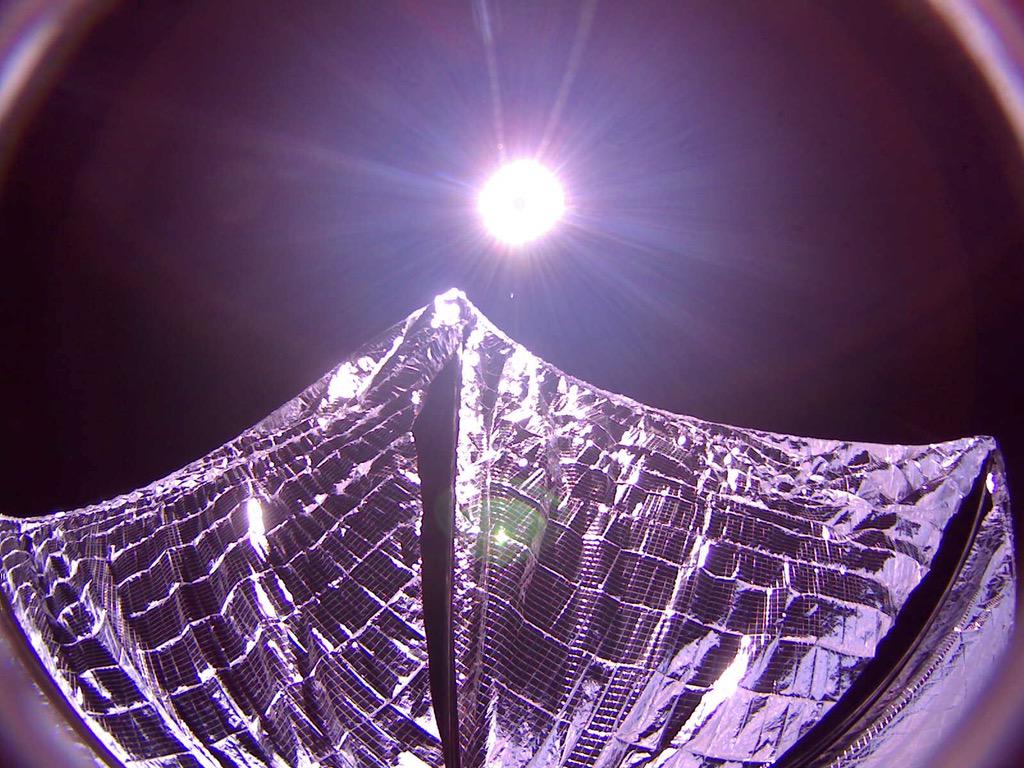
Photo from June 9 tweet by Bill Nye 
CEO of the Planetary Society

In a tweet Bill Nye The Science Guy describes this photo as "a complete image of #Light Sail in space! The future of space travel . . ."

This light sail launched on May 20 as a test, an early step toward the goal to "sail a spacecraft no bigger than a bread box, on beams of light," he said. "Imagine it: unlimited free energy from the Sun will provide CubeSats with propulsion and revolutionize access to space for low-cost citizen projects. This means that spacecraft, especially small ones like CubeSats, won't have to carry heavy fuels into orbit, and that the acceleration will be continuous."

Two days after launch a software glitch made the little satellite unable to deploy its sail. On May 31, contact was made and on June 3 the solar panels were deployed. June 4 communications were again lost, but on June 6 communications were restored sail deployment commenced on June 7. On June 10 photos (including the one above) were successfully downloaded as well as extensive data.

The original plan was for the satellite's orbit to degrade within two to ten days following sail deployment, and fall back to Earth, burning up on reentry. LightSail-A made its fiery reentry June 14, its mission a success.

In Murder on Ceres, my science fiction/murder mystery, the loss of a solar sail proves to be an important plot point.

"Solar Sail Sakurakaze with Mark A. Warner aboard unaccounted for. No contact. No request for assistance."

"Aptly named, the Sakurakaze looked like a sakura blossom. Its five sails extended radially in graceful curves, each with a notch in its distal end. The furled sails would open as she pulled away from the dock. Like a flower blooming."

Specs on Warner's solar sail read as follows:
"Four-passenger sport class Kono II with Stang auxiliary thrusters. It could reach more than ten times enough velocity to escape Low Ceres Orbit. Enough to escape Low Mars Orbit."

The Deuce was constructed of carbon composite to reduce over-all weight without sacrificing strength and durability, the cabin hung below the sails. The builder's description was pure promotion, "Its black exterior reminiscent of ancient Japanese lacquer ware. The interior finished in synthetic teak and white ceramic, for the warm look of wood and the classy simplicity of porcelain, while staying well within weight limitations."

The future is now.