Showing posts with label Murder on Ceres. Show all posts

Thursday, April 27, 2017

U, V, and W -- Nonfiction


W Is for Writer 

I am a writer. I have one novel in print Murder on Ceres. It is available from Amazon as both a paper back and on Kindle. And I'm currently working on the next in what I plan to be a series of four.

At some point several years ago I decided to do what I've always wanted to do -- write a book.

Although my fiction reading is eclectic (some would say indiscriminate) my fiction goto's seem to be murder mysteries and hard science fiction. So I wrote a science fiction/murder mystery or maybe it's a murder mystery/science fiction like I would like to read. The story is set in the future when civilization is centered in the Mars colonies and Earth is truly the "old country" but humans are still humans and murder happens.


"Balancing the demands of his job and his responsibilities to his family, Rafe investigates the suspicious death of a Ceres Colony Consortium accountant. Suicide? Overdose? Homicide? Not his upcoming trip to Earth, not his independent and fiery wife, nothing will keep him from the case.

"Through a whirlwind of illicit drugs, space pirates, and secret identities, Detective Rafe Sirocco chases the truth all 266,000,000 miles from the shining cylinder of Ceres Colony to the alien landscapes of Earth. But will he make it in time to save the one person that matters to him most?"


My nonfiction reading is equally eclectic -- Stephen J. Gould, Neil deGrasse Tyson, Carl Sagan and Isaac Asimov (yes, they wrote nonfiction which I actually like better than their fiction.) David McCullough, Carl Sandburg (his Lincoln and his poetry,) Maya Angelou, Shel Silverstein, Dr. Seuss, etc., etc., etc.

If I had written a U-blog, it would have been about the Universe just because it is so beautiful and I could use pictures from the NASA/ESA Hubble telescope like this one.


Close-up of M27, the Dumbbell Nebula

Their name for this photo. Imagine calling this a "close-up."  It is more than 1,200 light-years away. A light year is the distance light can travel in one Earth year which is nearly 6 trillion miles. Now multiply that time 1,200 and this is a close-up.  This glorious display of color is the result of an old star that has shed its outer layers. Discovered by French astronomer Charles Messier in 1764, a dozen years before the Revolutionary War, it was the first planetary nebula discovered.

And had I done V-day, it could have been Voyager 1. On September 12, 2013, NASA and the Jet Propulsion Laboratory confirmed that Voyager 1 had indeed left our Solar System and entered interstellar space. Where is it today? Click here for a real-time odometer of Voyager 1's distance from the Earth and the Sun in astronomical units (AU) and kilometers (km).

Better yet, The Golden Record.


It is "a kind of time capsule, intended to communicate a story of our world to extraterrestrials. The Voyager message is carried by a phonograph record-a 12-inch gold-plated copper disk containing sounds and images selected to portray the diversity of life and culture on Earth."


#atozchallenge

Thursday, July 28, 2016

Star Trek Beyond -- A Review

Star Trek! 

Let me just start this review with what they did right.

James Tiberius Kirk played by Chris Pine -- a little preachy, a lot earnest -- check.

Spock, Zachary Quinto -- quite attractive, appropriately serious, just a dash of delightful naivete, maybe a shade too much emotion but then he's romantically involved in this film -- I'll give him a Yes!

Uniforms -- also a Yes! A bit Michael Jackson if he'd ever worn denim and I did question those chain-suspendery things. Looked too much like really big, beer can pop tops. But hey, I'm into repurposing as much as anybody.

Makeup -- Excellent. The new girl especially.


Sofia Boutella plays Jaylah, a brash, competent, beautiful alien who has the coolest special effects in the film. She does this hologram-multiplication trick that is spectacular.
  And the bad guy, Idris Elba as Krall. I like the little LEDs along his ridges.


The opening scene gets a Yes! Captain Kirk is presenting what he thinks is a precious symbol of peace, a gift to the gargoyle-ish Teenaxi from their arch enemies the Fenopians. It's a typical Kirk scene. It reminded both my husband and me of our bad cat Kocka.

(For those of you who don't know about Kocka, he's a fluffy grey cat who's more than a little prickly. I have scars.)

And the space station Yorktown is bright and beautiful which is exactly how I imagine the future to be.

I've been a dedicated Star Trek fan since Gene Roddenberry took us on that first five-year mission of the Star Ship Enterprise into Space, the final frontier to explore new worlds, to seek out new life and new civilizations, to boldly go where no man has gone before. (Can't you hear the music welling in the background?)

That was in 1966. The shows were filled with humor and new ideas and people and creatures who didn't look like everybody else on TV.

The wit and wisdom has been replaced by shock and awe. Where we used to have characters with dialogue, they give us explosions and the tinkling of broken glass. So, okay, I like 3D. I like XD. I like flashing lights and loud noises. I mean I've been to a Jefferson Starship concert where I could hold my hands against my chest and FEEL the music. My ears rang for days.

But Good Grief! Enough is enough. And the celebration of modern movie technological marvels should not replace wit and wisdom. I mean the best lines were from Scotty, played by Simon Pegg -- not surprisingly one of the screen writers.

I love science fiction. I write science fiction. Check out Murder on Ceres.

But this is the last Star Trek movie I'll spend my time on. I actually fell asleep watching it. How could it be so boring with all that noise and bother?

Maybe I have entered my curmudgeon-hood. Now "Get off my lawn!"

Tuesday, April 12, 2016

Justice -- Reality or Illusion?


I am real. I am typing this right this minute. The letters are appearing on my laptop's screen and forming into words. Into sentences. Forming symbols that will convey my understanding of Justice to anyone who can read English.

Reality or Illusion?

I might be an app and if I am there would be no need for me to use a keyboard. And this minute could have been hours ago. Or days. Or years. The letters may never have appeared on any screen until you started reading this post. And, I can assure you, only I will understand the thoughts I write exactly as I intend them to be understood. And that's just for today. Some tomorrow, I will have forgotten most of today and experienced enough of life to change my understanding of Justice.

Merriam Webster defines Justice as:
1   a :  the maintenance or administration of what is just especially by the impartial adjustment of
           conflicting claims or the assignment of merited rewards or punishments
     b :  judge
     c :  the administration of law; especially :  the establishment or determination of rights according
           to the rules of law or equity
2   a :  the quality of being just, impartial, or fair
     b (1) :  the principle or ideal of just dealing or right action (2) :  conformity to this principle or
           ideal :  righteousness
     c :  the quality of conforming to law

I want Justice to exist, especially the fair part.

We humans are not alone in this. My husband and I used to have two dogs. Oscar a Dachshund and Bess the Basset Hound. (Actually, we've had many dogs, though never more than three at a time. And cats and birds and fish. And the idea of wanting fair treatment has been observable in all of them. Well, maybe not the fish. I never got well enough acquainted with individual fish to be able to ascribe to them any particular interest in anything other than food and sex.)

Anyway, Oscar and Bess liked to lick our yogurt cups and ice cream bowls. When there was only one for us to share with them, we had to give the other a doggy treat. Even then, they could hardly wait until their sibling finished so they could get a chance at the cup or bowl. They made it quite clear that they did not consider a Milk Bone in lieu of the yogurt cup or ice cream bowl, fair.

I think the desire for Justice is the driving force for the popularity of fictional murder mysteries. Although true crime inspires many nonfiction books and television shows, it's fiction I like. In a novel, TV show, or movie you almost always find out who done it. And the murderer is dealt with, promptly and without regard to their family or financial status. That's fair.

Unless, of course, the accused is innocent, then Justice is served because they are acquitted and the right baddie is identified. We're still talking fiction here.

That's why I write Science Fiction/Murder Mysteries. (Murder on Ceres)

Real life and true crime stories don't work that way. In real life, unless you personally know who done it (or maybe you did it yourself) you can never be sure that the right person is 'brought to justice.' And all too often the application of Justice is capricious and random.

Reality is if you get caught smoking a joint in the privacy of your own home in Denver, you might be considered inhospitable if you don't offer your guest a hit.

Get caught smoking a joint anywhere in Oklahoma and you could face a felony charge and one year in prison. Get caught again, and you could be looking at two to ten years incarceration.

More reality, in Oklahoma, a person can get convicted of First Degree Rape and be sentenced to five years. Or anything up to life without parole. Or the death penalty.

Wait a minute -- step across the Colorado State Line into Oklahoma and get caught more than once smoking a joint and you could be sentenced to more time in jail than someone who gets the minimum sentence for First Degree Rape. That can't be fair.

Ah, the reality of Justice is murky water meandering through a dangerous bog. (That's why lawyers get the big bucks.)

Now, I'm not a lawyer and I sure ain't gonna smoke marijuana in Oklahoma.

Think I'll stick to fiction where Justice is the kind of illusion I want to be real.

Monday, April 4, 2016

Character Introduction -- Novel Excerpt


My novel-in-progress Dead and Gone is a follow-up to Murder on Ceres, a science fiction/murder mystery. Joe is native to Ceres Colony, temporarily assigned to Earth, what is to him an alien planet.

Chapter 1

Joe passed the flashball to Joey. The little boy blocked it with his chest, let it drop to the ground, then dribbled past him. The kid was a natural, Joe hardly had to ease his defense at all. Not that he had a problem letting his boy do well against him. His own father had always played easy with him. His Dad didn’t believe a father should compete to win against his son. Brothers, yes. A rival team, of course. But competition with a kid whether on the pitch or in cyberspace was to train the child, not to beat him.

Bright light tugged at Joe’s eyelids. The flashball pitch and his son disappeared. He clenched his teeth against the cold. What was that smell? Smoke. He hadn’t heard the alarm. What the frak? Sounds, yes. But no alarm. Twittering sounds and rushing water. No emergency responders. The smoke sensors must have failed.

Something snuffled at him.

Dream or reality? Fire on the colony was never a good thing. Toxic fumes. He’d suffocate before he burned. He had to wake up. Had to get out. He tried to yell, but only groaned.

“Stay still,” someone said.

He struggled awake. A shadow blocked the sunlight. What he saw made no sense. A head, an enormous hairy head hung above him, silhouetted against the sun. He couldn’t see details. At least no details he recognized. No eyes. He saw nostrils half as big as his hand.

The sun? Where was he?

“Be quiet,” the voice said. “Just take it easy. She’ll move away. She’s just curious.”

Earth. He was on Earth and this was no frakking dream. He was trapped, wrapped in some kind of fabric, lying on the ground. Unprotected. Unable to move. With an animal standing over him.

The animal raised its head, enough so he could see more than its muzzle. It shook its head, slinging snot and saliva. Loose lips flapping like a banner in the Earth wind. Then it walked away. Ears twitching forward and back, its huge body swaying on stilt-like legs ending in hooves. Surprisingly delicate hooves considering the size of the animal.

“Moose,” Sheriff Macy said.

Joe watched the animal disappear into the pines. Or maybe they were fir trees. He didn’t know and he didn’t care. That animal was too big and too damn close.

Sheriff Macy poured a cup of coffee. “Don’t see many moose on Ceres Colony do you Hudson?”

“You’re damn frakkin’ right about that. Don’t want to see any more of them that close here either.” He wiped his face, climbed out of the sleeping bag, and accepted the coffee.


Friday, February 19, 2016

Jo Nesbo's Harry Hole Series -- A Review


A friend who knows that I like detective stories recommended I check out Jo Nesbo. 

Being a provincial American, I automatically thought since the name was spelled Jo that the author was a woman, which put her at the top of my to-read list. (I know. I know. I'm a sexist. My daughter has tried to cure me of that for years.) 

Well, Jo is Norwegian and male. And, being Norwegian, the 'J' is probably pronounced like a 'Y.'

I didn't bother to Wiki him until I finished a second reading of the first in his Harry Hole series The Bat. The first time I read it, I thought it was interesting. It takes place in Australia and as Harry learned more about the setting, so did I. Seemed odd for a cop from Oslo to be investigating a murder in Australia, but it works. 

The reason I read it a second time, was that I ran out of anything to read one night. I'd been reading mostly nonfiction and The Wheel of Time series for the umpteenth time. I bought and downloaded a science fiction novel, but it was badly formatted and I couldn't read it. (A trip to my local Barnes and Noble got that fixed for me. And I needed tea. That's one of the big differences between B&N and my local library. The library doesn't sell tea or chocolate mousse.)

Anyway, I needed something to read and I didn't want to spend any more money right then. Being a sci-fi/murder mystery writer myself (Murder on Ceres) I thought I should stay in my genre. So I read The Bat again. 

This time around, Nesbo's character Harry Hole was more interesting than the exotic setting. I went from there to Cockroaches, the second Harry Hole novel. It takes place in Thailand. Again, it seemed odd that Harry was trying to solve a murder in a country so far from his home. I got the feeling that the Oslo Police Department must have a much larger budget than my town's PD has. Or maybe Norwegian detectives get special discounts with the airlines.

After the second book, I was hooked on Harry. He does follow the rules, meaning the laws that defend the innocent and bring to justice the guilty. He does not, however, follow orders well at all. He's alcoholic. He's got baggage. He makes bad decisions. He takes unnecessary chances. I would not like to be his boss. But he connects with others and his intentions are good. He cares. I wouldn't hesitate to be his friend.

And he solves crimes. Crimes that involve people in sensitive, political situations. Lucky for him. Because his own foul-ups get glossed over while those above him in the political food chain are being protected.

Like I said, I was hooked. Next I read The Redbreast. Harry is at home in Norway. A love interest is introduced, Rakel. He has a partner, Ellen. She is an excellent detective and accepts Harry pretty much as he is. There is information about Norway in World War II, that I knew nothing about. Information that figures heavily in solving the crime.

In The Redbreast, another crime is introduced, one that is not solved, but carried me head-long into the next book, Nemesis.

In Nemesis, bank robberies and murder are the crimes to be solved. Another new character comes on the scene Beate. She works in forensics. Beate Lonn (spelled with a slash through the 'o') it seems has a super sensitive fusiform gyrus. What's that, you ask. It's that part of the brain related to facial recognition. She can remember every face she's ever seen.

Our Harry proves himself to be his own worst enemy. Thank goodness for his friends who love him anyway. Together, they figure out the robbery/murders, but do not solve the greater, ongoing problem within the police department.

I am so glad we can buy and download ebooks. As is not uncommon, I needed the next Harry Hole book after normal business hours.

And then The Devil's Star. An excellent end. After solving a series of ritual murders, the police department is saved from itself. And, just when I'm getting fed up with Harry's self-destructive ways, he somehow pulls through and I have hope for his future.

The first two Harry Hole novels are worth a read, but I would recommend you skip them and go right to The Redbreast, Nemesis, and The Devil's Star.

As for me? It's back to nonfiction -- Sue Klebold's A Mother's Reckoning.

Someone of interest to me is Don Bartlett, Nesbo's translator. Seeing as how even after reading Stieg Larsson, I still don't speak Norwegian. (Wait! No, you're right. Larsson was Swedish.) I did watch all the episodes of the TV show Rita, which I loved. (But that was Danish.) 

The work of translating fascinates me. Where is Bartlett from? What is his first language? Some of his word usage struck me as strange. He wrote "shone an apple on his sleeve" where we would have used "shined" and he uses the term "skip" which I figured out was a "dumpster." English is his first language and England is his home.

Ah, yes. Two nations divided by a common language.

Saturday, January 16, 2016

The Pluto Files -- a review


See all those pink Post-Its? They mark things I wanted to quote in this review; new bits of information I wanted to remember; funny things he said that I wanted to tell somebody -- my husband, my daughter, anybody who'd listen.

Too many, too many.

In The Pluto Files: The Rise and Fall of America's Favorite Planet, Neil deGrasse Tyson tells the history of not just Pluto but of our understanding of our solar system.

He explores America's proprietary attitude toward Pluto. Pluto has always been practically an American planet. It was, after all, discovered by an American and made famous as Mickey Mouse's best friend. How more American could it be? How could it be demoted from its planet status by a bunch of mere scientists?

Tyson recounts his own part in that demotion. The decision to exclude Pluto from the new Rose Center's exhibit of Solar System planets was made in order to save money should discussions, then ongoing in the world of cosmology, redefine 'planet' making Pluto no longer a planet and instantly rendering the exhibit wrong. 

Not because he led the anti-Pluto-as-a-planet movement, but because he was Director of the Hayden Planetarium and he had tacitly accepted the role of astrophysics-interpreter-in-chief, he was the lightning rod. He drew the fury of the American Press and school children from across the country, incensed and offended that their planet was no longer officially considered a planet. 

Third grade teachers throughout the nation recognized a teaching moment. 


And suddenly, Tyson (not the boxer) was a household name. Not, in my opinion, a bad thing. Anything that focuses America on something scientific rather than sports has got to be good -- any publicity is good, right? Even bad publicity. Or detestations from third graders.

And it wasn't just children. Songs were written. Editorial cartoons were published. Comedians had fodder. And other scientists, even astrophysicists, took professional exception.

There were debates. According to Tyson's accounts these debates were every bit as passionate and acrimonious as the current crop of political debates, complete with verbal fireworks. (Though I don't think birther considerations came into any of them.)

The International Astronomical Union did not define 'planet' until 2006. The same year the other Tyson retired from boxing and six years after the Rose Center opened setting off the Pluto-as-a-Planet controversy.  

But more seriously, how can it be that physicists come so late to the method of taxonomy long employed by biologists? Tyson does not explain that, but he does explore the current modes of organizing the celestial bodies by their physical properties.

As the brouhaha subsided, the letters from children changed. This letter Tyson received from 8-year-old Siddiq summed it up. "We just have to get over it. That's Science."


As all good scientist should do, indeed sensible humans of any stripe should do with any of our life questions, Tyson leaves open the possibilities of new information changing our closely held views of reality. Again.

To give Pluto the last word, Tyson shares how political cartoonist Aislin in the Montreal Gazette imagines Pluto's concern with all things human: 


Probably the best news for me is Tyson identifies Ceres as a Dwarf Planet. It was the largest of the asteroids in the Main Asteroid Belt when I first started writing Murder on Ceres. A novel my husband describes as science fiction for people who like murder mysteries and a murder mystery for people who like science fiction. 


Monday, January 11, 2016

David Bowie


video from Youtube

David Bowie has had so many faces I couldn't pick just one to go at the top of this post. It came down to the fact that a static photo would not do. No matter of him as which persona or in which costume or with which face.

'Space Oddity,' my favorite David Bowie song, was released as a single in July, 1969. The above video was made at the same time.

I was a young adult and the song captured my sense of being hurled into the unknown with no tangible life support. Instructions from Ground Control (advice from my society) seemed too conventional. Completely irrelevant to my own weightless, planetless state.

At the same time Neil Armstrong stepped onto the surface of the moon. He traveled through that weightless, planetless state to arrive safely on the moon and opened the entire universe to humanity. Me included.

Like Bowie, I tried on a vast array of personas. I used to think our wanderings were peculiar to the 60's generation. Not so. Just ask someone--anyone--from the generation who survived the Great Depression and World War II to today's Millennials who try to make sense of their world.

And here is where and who I am. I write about life in space. Murder on Ceres. I follow the International Space Station on Facebook. I celebrate each new step into space by many governments around the world and by as many private businesses. These things didn't exist in 1969.

Tomorrow is still unknowable and scary for all us Major Toms. And conventional wisdom still does not relate.

Bowie spoke for me and Neil Armstrong spoke to me. Now they're both gone. But I'm still here and as long as I am, I've got to be willing to make that leap. 

WE are still here and WE must be willing to make that leap.

video from YouTube
First space music video. Commander Chris Hadfield performed
'Space Oddity' on the International Space Station,
44 years after Bowie's original video.


Monday, October 26, 2015

The Art of Misdirection

image from  ite.org

"The cat made a mess on the floor," my husband announces in disgust.

I am half asleep and, truth be told, I don't want to wake up. The bed is warm and I am snuggled into that perfect place where the pillow fits your head just right, the blankets are swaddled close so there are no drafts anywhere. And nothing aches. This early in the morning, any morning, having no aches is a miracle and I don't want to tempt fate by moving.

As you may know, I write murder mysteries -- Murder on Ceres. To begin the mystery, there must be a murder, or at least a dastardly deed. In this case a catastrophe. So I, the reader, am on the hook wondering exactly what has happened. And the misdirection is a simple lack of information. I'm allowed, nay encouraged, to imagine my own misdirections.

A mess? Without moving a muscle, my mind races through the possibilities -- in descending order the worst possibilities first.

Diarrhea. Cat diarrhea would surely be the worst. Kocka has never had diarrhea. (Kocka, pronounced kotch-ka with a long o. It means cat in Czech.) I know he hasn't had access to anything unusual to eat. Though I did see him toying with a small jumping spider. Would that upset his digestive system?

A hairball. The damned cat has long hair. Ooooh, I hate stepping on a fresh hairball, barefooted. No wonder my husband sounded disgusted.

I don't open my eyes. I don't ask what kind of mess. I just hope my dear, sweet, kind husband will clean it up and let me go back to sleep.

I read murder mysteries -- John Lescroart is my favorite. I watch murder mysteries on television -- Midsomer Murders, which my husband refers to as the Gilligan's Island of cop shows. Mysteries use misdirection.

To make a good story, misdirection must be done properly. Like the picture at the top of this post. The misdirections must let the reader imagine several directions, gradually moving through the possibilities.

The best misdirections do not seem contrived. They don't flash like neon No Vacancy signs. They just offer a nod toward the husband as the killer. If the misdirection were too obvious, we Americans would be convinced it was a red herring.

(Having been raised on Oklahoma Prairie and now living at the foot of the Rocky Mountain foothills, I don't have a clue what a herring is -- red or otherwise. I do know it's a fish of some kind. Not a trout or a farm-raised catfish, both of which are tasty, tasty.)

Maybe I should write a murder mystery involving a husband who not only is the most obvious killer -- BUT who, in fact, done the dirty deed. Oooooh. Then the misdirections would have to be tasty, tasty. He'd be so aggrieved -- mostly. And solicitous of his poor, dead wife's family -- maybe a little too solicitous of his wife's younger, blonder sister.

"He's shredded paper," my husband declares, merely disapproving.

That's not so bad, I think.

Maybe this is the most devious misdirection of all. A possibility that it's not a crime. Maybe an accident. Suicide. I can relax a bit. Have some sympathy for the poor widower -- errrr, cat.

And then the mystery writer drops the hammer. Our hero is about to be bludgeoned in the dark, dank basement.

Did I leave one of those checks from the insurance company where Kocka could get it? Or is it the latest iteration of  my last short story. Have I backed that up? What changes had I made? God, I hope it's not really my "last" short story. Surely I can write more.

In the end, the solution to the mystery must be congruent with the general direction of the story. Nothing out of the blue.

"It's toilet paper," my husband says.

Toilet paper? But my husband is discussing a mess the cat made at the door into the hall. Our bathroom is all the way across the bedroom. Kocka is famous for unrolling the toilet paper beside the toilet, but how could he get toilet paper from the bathroom unrolled all the way to the hallway door?

I can't lay in bed any longer.

Indeed, my husband is standing over a mostly shredded, one-quarter-full roll of mangled, only slightly damp, toilet paper.

Oh, I see.

A couple of days before I'd discovered that same partial roll of toilet paper in the toilet in the main bathroom. No doubt knocked into the toilet by a certain long haired cat. I'd fished it out (the toilet paper not the cat) and dropped it into a plastic basin on the counter beside the sink, intending to return soon and dispose of it properly. (What is it they say about the road to hell?)

The main bathroom door is a scant two feet down the hall from our bedroom door. Figure maybe four more feet to where the basin in question -- now empty -- rested upside down on the floor. Kocka carries things in his mouth. (Maybe he was a dog in one of his last lives.)

No more misdirection. Mystery solved. In fact, two mysteries. We'd heard a muted crash in the night, my husband and I. We both said, "The cat." Rolled over and went back to sleep.


Monday, October 12, 2015

The Martian -- a movie review


image from wallpapershome.com

My husband and I went to the movies this afternoon. We saw "The Martian." To see it regular would be $5.15 per ticket, 3D $8.15, and 3D XD $15.15. We opted for the plain 3D, 'cause I like 3D but not $10 worth.

There are two kinds of science fiction -- hard science fiction and soft science fiction. Hard science fiction emphasizes scientific and technical possibilities consistent with our current understanding of science and technology. Soft science fiction plays fast and loose with the science. That leaves it free to tell whatever story it wants.

I love science fiction movies where the movie makes no pretense to serious science. The Star Wars and Star Trek franchises come to mind. They're exciting, visually stunning, and explore themes of universal human interest.

I write hard science fiction -- Murder on Ceres. It's available as a paper back and on Kindle. Check it out.

I would love to see science fiction movies that explore real possibilities. Stories that stay within the realm of scientific and technological possibility. We live in an age when we should be able to see movies like that. We really will be sending astronauts to Mars. The science is available. It is not beyond the normal human being's capacity to understand. And it is more amazing and thought provoking than the misrepresentations presented in "The Martian."

I guess that gives away my rating on this movie. I give it a 57 1/2 because you can dance to it.

Let me tell you what I liked about the movie first. Then you can stop reading if you don't want to know what I didn't like about it.

What I did like:
The visuals -- especially the Mars scapes. Broad empty land with dramatic rock formations. Reds and ambers, The deep blackness of space sprinkled with stars. They did distance very well. I liked the vehicles, too. (At least before the modifications which can only be described as dumb. Think visqueen and duct tape. Seriously? Seriously!)

Sorry. I was going to do the positive stuff first.

I loved the spaceship Hermes. Matt Damon does a good job acting. And Benedict Wong represents the JPL well. I always like JPL being mentioned whether in the news or movies. And NASA is my favorite government agency.

You know what? I'm not going to rant about the lights inside their helmets -- you already know how hard it is to see out of a car at night if the dome light is on. And surgical staplers don't sound like staple guns. And jumping up and down on a roof at Earth gravity does not equate to jumping up and down on a vehicle's roof at Mars gravity. (Mars gravity is 0.38 of standard Earth gravity. So a 185 pound Matt Damon on Mars would weigh 70.3 pounds -- not quite as much weight to throw around.) And hydrogen doesn't burn yellow.

But it makes sense that you could grow potatoes the way they do in the movie. And the movie does seem as long as it would actually take to travel to and from Mars.

I restrained my urge to laugh until the last ridiculous stunt. I mean with broken ribs? Come on.

But then when the movie was finally over, my husband took me to Barnes and Noble where I had a lovely cappuccino and chocolate mousse in their Starbucks. 

And I eagerly anticipate the next Star Wars movie.


Monday, October 5, 2015

A Book Signing

image from tatteredcoverbookstore.blogspot.com
Diane Mott Davidson 

Diane Mott Davidson, writer of culinary mysteries, signed books at Mountain Books in Conifer, Colorado, October 2.

She is gracious, delightful, and entertaining whether you're listening to her speak or reading her stories. And she makes a mean batch of Scout's Brownies from her book, Dying for Chocolate. 

That's the first book of hers that I read. Her main character Goldy is a mother, a good friend, a domestic abuse survivor, an amateur sleuth, and a caterer -- in that order of importance. As the series continues she adds wife to that list -- I would say tying for slot number 1.

In Dying for Chocolate, we meet all the main characters. Goldy, of course. She is happily divorced from The Jerk whose only positive contribution to her life is their son Arch. She has turned her passion for food into a career as a caterer. 

Marla is the Jerk's second ex-wife and Goldy's best friend. Marla has an extraordinary talent for collecting the town gossip which proves invaluable to Goldy's avocation as amateur detective solving local murder mysteries.

You know that info on the back of books? I seldom read that. Or book reviews. I read books because a friend recommends it or I hear an interview with the author on National Public Radio. But Dying for Chocolate I saw in the library and being notoriously addicted to chocolate, I checked it out based solely on its title.

Like all of her mysteries, it's set in the imaginary town of Aspen Meadow, Colorado, which is very like her town of Evergreen.

I was innocently reading along when I turned a page and there, in the middle of the murder mystery, was a recipe. That was on page 75. Then on page 98 there was a recipe for Scout's Brownies. To the kitchen! Murder mystery on hold, I baked them. They were delicious. 

Lucky for me because I lived in Oklahoma at the time, Ms. Mott Davidson had amended her high altitude recipe for us low altitude readers. I didn't find that out until the book signing. 

I've read all her books since. She inspired me to write Murder on Ceres. I took her a copy of my book as a gift.

I found out on Monday about her Friday scheduled book signing at Mountain Books in Conifer (from Colorado Public Radio, our local NPR station) and, of course I had to go. I'd never been to Conifer. I knew it was in the mountains and it would likely be dark when it was over, so I set about trying to enlist people to go with me. Daughter had to work. Husband had to work. Friends had other commitments. Well, shoot.

Conifer, Colorado. Google said thirty minutes away from my house. Four-lane highway. How bad could it be?

I left home at 4:00 pm to be sure I'd have plenty of time to find the book store and a parking place. After all, I clearly remembered my experience in February at Neil Gaiman's book signing in Ft. Collins,

There was a bit of rush hour traffic. It always amazes me how many people live up in the mountains and commute into Metro Denver for work. Needless to say, it was all uphill and curvy. Exits marked roads named "Raven Gulch" and "Sourdough Drive" and "Alpine Meadow." Of course they did.

The drive up? No problem at all.


Mountain Books is a wonderful bookstore. It's small and stuffed to the gills with books, new and used. Jesse, the owner, has been in this location for 18 years. His space is divided into categories -- Science Fiction, Mysteries, Religion, etc. and the books are shelved within those categories alphabetically by author. That pleases my library-trained heart.

His dog Sasha welcomes customers and keeps an eye on everything. Of indeterminate ancestry, she's a mature dog, about 30 pounds, mostly white with a lovely black patch over her right eye. Her coat is medium length and her tail is elegantly feathered. Most of the customers are local and they obligingly toss her ball for her to fetch.

Jesse suggested I walk over to the shopping center where there are several eating establishments. Of course he did. Everybody in Colorado walks. I'm getting used to it.

Weather Underground  forecasted possible thunderstorms for Conifer. Clouds were building, but to the east. 


They might drop rain out over the prairie but it wasn't likely I'd see anything from those clouds. And the aspen are responding to our changing fall daylight, their leaves bright as sunshine shimmering in the wind.

I bought Mott Davidson's latest, Goldy's Kitchen Cookbook, a collection of the recipes from her culinary mysteries, and sat down to wait. 

More fans filtered into the bookshop and we visited. One lady told me I was brave to drive in the mountains after dark. I decided to see what other books of interest to me Jesse might have. I found a Stephen Jay Gould I didn't have and one by Neil deGrasse Tyson -- both used for only $5 each.

One of the ladies said she got to hear Tyson speak at Colorado School of Mines a couple of nights before. How cool is that!

Another woman said I should be careful driving after dark because of deer on the highway. And elk are bigger than deer. Another said she'd seen a bear dead on the road the night before. Several agreed they'd heard someone hit a bear. "Do you know who?" they asked each other. "A bear?" I asked. "But they're not as dangerous as hitting a deer," they reassured me. Or an elk "because deer and elk are so tall, they'll come right over the hood into your windshield." 

Which brought on one woman's husband's experience with a deer leaping through his pickup truck's side window and going halfway through the windshield. "It was dead, of course." Of course, I thought. Then someone offered the wisdom that it would have been more dangerous if the deer had not died -- "flailing around in the moving truck."

Deer and elk and bears, Oh my.

To my relief, Diane Mott Davidson arrived bearing freshly baked Scout's Brownies. And signed our books. She talked about who inspired her villains -- which brought to mind Twain's warning that you ought not start a fight with someone who buys ink by the barrel. She explained that her husband Jim is nothing like the Jerk. And Arch is so believable because she has her three sons to draw on. 

Her husband is an aerospace engineer and has worked for NASA. She thinks he'll enjoy Murder on Ceres. Not only a wonderful writer, but she's kind, too.

And then it was time to drive home. In the dark.

When you see those yellow diamond highway signs showing a downward tipping truck above the percent grade you're coming to, you know you're in the Rocky Mountains and it's going to be steep. And yes, I do know to take those long, steep hills in Low gear, so my brakes don't overheat and fail.

After a half mile of 5% grade, (Doesn't sound like much, does it? But it is very steep.) I encountered an official Department of Transportation sign that read "ALL DRIVERS DON'T BE FOOLED 5% GRADE AND SHARP CURVES NEXT 5 MILES." Scared me, I'll tell you.

But then, it's like my husband says, it's not quite so scary when you can't see how far down it is. And in the darkness I couldn't see anything past the edge of the road. That's because the ground fell away to my immediate right and there was nothing there to be caught in my headlights.

At least I didn't have to worry about a deer or an elk or a bear leaping in front of the car from that side of the road. I just had to keep reminding myself that if one of those critters did come out of the darkness to my left, I should probably not swerve right to miss it.

I was relieved when I saw the 65 MPH speed limit signs. I knew I was out of the mountains and almost home.

Friday, August 14, 2015

Writing Contest


They're gone! My entries for the annual Rose State Writer's Short Course competition are in the mail.

No more editing. No more rewrites. No more thinking and rethinking. Questioning, doubting, second-guessing.

"Heroes," my entry for Flash Fiction is my absolute favorite. It is my way of honoring all those mothers out there who allowed their children to do dangerous things because those things needed to be done. Like my friend Allegra's grandmother who let Allegra's mother take part in the lunch counter sit-ins in Oklahoma City in the late 50's and early 60's.

Flash Fiction is almost poetry. It must tell a whole story in two or fewer pages. That means the writer must use the absolutely, most evocative, right word -- Hemingway's mot juste. The writer must engage the reader's experiences, their sensory memories, their fears, their dreams, and their hopes. And, most importantly, the writer must trust the reader to be willing and able to participate as an involved reader.

"Dead Birds and Broken Bottles," is creative nonfiction -- a new field for me. The trick to creative nonfiction is that it has to be true. Somehow my personal experiences have just never seemed exciting enough or well-plotted without embellishment. Or they were too personal and I was not comfortable being a character in my own story. Or somebody would get their feelings hurt and get mad at me. It wouldn't be safe to accidentally meet them at the local Walmart.

Everyone, no matter where they live, has a weather or natural disaster story. And being from Oklahoma, tornadoes lend a certain excitement to my own memories. Living in a small town offers all kinds of interesting characters. So I had the excitement and the familiar characters for a nonfiction piece. Then the creative part was to turn the factual time-line into a plot.

This particular tornado happened more than half a century ago so most of the characters are dead now and not likely to show up at Walmart. I'm feeling relatively safe in that respect.

Then there's "The Girl in the Reeds." Those of you who know me, know that I am particularly fond of mysteries. Murder mysteries.

Because I am currently working on a follow-up novel to Murder on Ceres, a Science Fiction/Murder Mystery, I didn't want to take time away from it to spend days and weeks on a murder mystery for this competition. I decided to write a murder mystery short story.

Keeping in mind that Murder on Ceres started out as a short story, this was a dangerous undertaking. I didn't know if I could write a mystery in short story form. Short stories are generally 7,500 or fewer words. I'd written short stories before, but not murder mysteries. The question was could I construct an interesting puzzle and solve it within that number of words.

And, you know what? I did. (Here insert a vision of a white-haired sexagenarian doing a happy dance, whilst humming the Theme from Rocky.)

I am excited. I am pumped. Look out, Oklahoma. I'm on my way!


Friday, July 10, 2015

The Cover Letter


“He’s a nice man,” my husband said.

I know, I thought. I can’t do that. He’s a busy man. Not to mention that I’m more than a little star-struck by him.

“Go ahead. Send him your book. He might like it.”

How cool would that be?!

My chest felt a sudden crushing sensation. You know, like right at the top of the first peak on the roller coaster. The last few seconds before liftoff. That feeling that something awful might happen.

“Write a cover letter and send it to him,” he said.

A cover letter. Of course. I was not at the brink yet. I would compose the perfect cover letter and mail Murder on Ceres to Neil deGrasse Tyson. He’s an astrophysicist. He can see that humanity’s future lies off-Earth. He knows we’ll still be humans and, with or without flying cars, he knows that the future will be normal for those humans who inhabit it. It will be different from today, but it will be just as normal to them as yesterday’s future is normal to us. He’ll get what I tried to do in my
sci-fi/murder mystery.

It could take days. That cover letter. Weeks, maybe.

I began the next day. “Dear Dr. Tyson.” The honorific Dr. is used only for medical doctors except in the South? I’ve been told. And how many times have I been told that all things Southern are somehow less-than? I think of my poetry teacher in college – Dr. Norman Russell, who was a botanist of the first order. A well-respected scientist AND poet who was originally from West Virginia and I’m originally from Oklahoma. Both states are definitely south of New York where Dr. Tyson is from. But Mr. wasn’t right for Dr. Russell and it didn’t feel right for Neil deGrasse Tyson so I kept the honorific.

I then proceeded to write what amounted to little more than a fan letter, telling Dr. Tyson how much I admire him and his work. That I never took issue with his stance on Pluto. That his Cosmos was great and that I was much relieved to hear him say such nice things about Carl Sagan. That I was impressed that he wrote essays for Natural History magazine home of another of my heroes Stephen Jay Gould. That he has a wonderful sense of humor like so many scientists do – Stephen Hawking being an excellent example.

I did show admirable restraint and didn’t mention that I think he’s hot.

I hardly mentioned my book at all.

My editor (who happens to be my daughter) and her friend kindly read my letter and suggested changes.

The letter morphed into a sensible communication that explains a little about Murder on Ceres and why he might enjoy reading it.

Murder on Ceres is an old-fashioned murder mystery set in the future. The story
itself follows intelligent, by-the-book Police Detective Rafael Sirocco, as he tries
to balance the demands of his job and his responsibilities to his family. Through a whirlwind of illicit drugs, space pirates, and secret identities, Rafe chases the truth
all 270,000,000 kilometers from the shining cylinder of Ceres Colony to the alien landscapes of Earth.
And a more reasoned description of my admiration for him.
I appreciate your treating science as “normal” and humanity’s future in Space
as inevitable. I am a great admirer of your work. I think you share my lifelong
passion for space travel and a faith in our future as a species. I hope you enjoy
Murder on Ceres.
Very truly yours,

I signed the letter, ate two left-over muffins, had another cup of coffee, headed to the post office.
I was going to lunch with a friend so I had on make-up and was wearing a dress. Did I mention that I was trembling as I handed THE ENVELOPE to the young woman behind the counter in the post office?
“Have a nice day,” she said.
“You have a nice day, too,” I said.
Then she said, “You look very pretty today. That’s a good color for you.”
Oh, my. Do you think that’s a good omen? Can I be forgiven a small slip of superstition?
I was over the first peak on the roller coaster. Free-falling. Murder on Ceres and its cover letter were away. Flying. That crushing feeling was replaced by exhilaration and I left the post office with one of those nonsensical grins that you just can’t contain.

I did it!

Wednesday, June 17, 2015

Science and Science Fiction

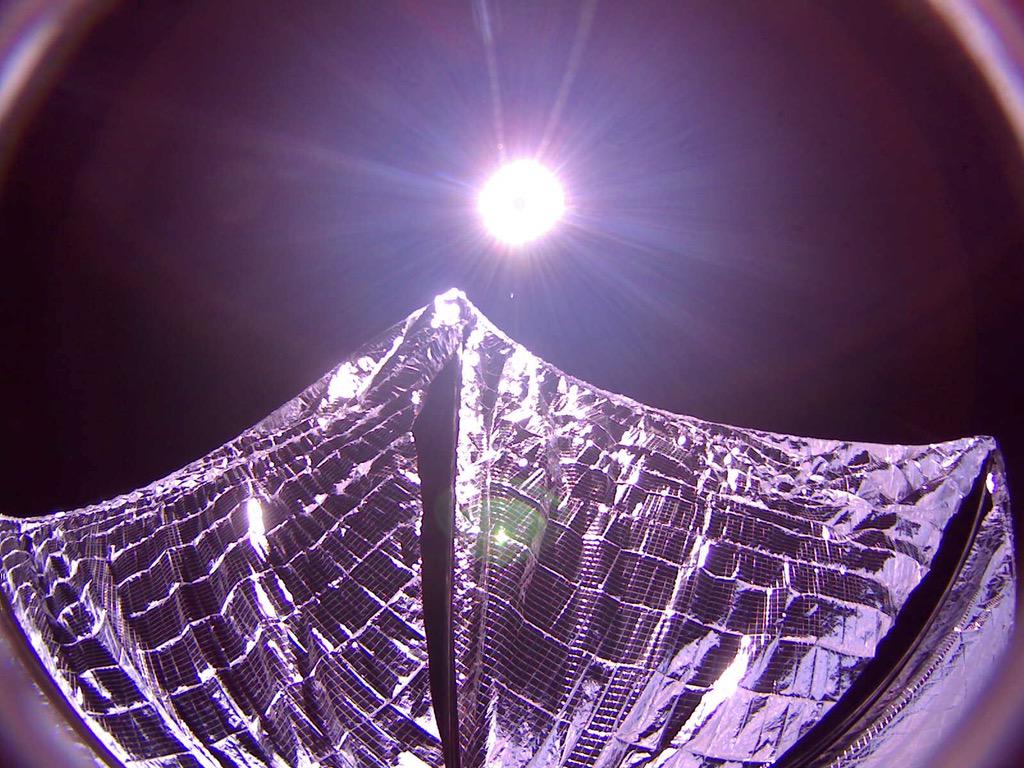
Embedded image permalink
Photo from June 9 tweet by Bill Nye 
CEO of the Planetary Society

In a tweet Bill Nye The Science Guy describes this photo as "a complete image of #Light Sail in space! The future of space travel . . ."

This light sail launched on May 20 as a test, an early step toward the goal to "sail a spacecraft no bigger than a bread box, on beams of light," he said. "Imagine it: unlimited free energy from the Sun will provide CubeSats with propulsion and revolutionize access to space for low-cost citizen projects. This means that spacecraft, especially small ones like CubeSats, won't have to carry heavy fuels into orbit, and that the acceleration will be continuous."

Two days after launch a software glitch made the little satellite unable to deploy its sail. On May 31, contact was made and on June 3 the solar panels were deployed. June 4 communications were again lost, but on June 6 communications were restored sail deployment commenced on June 7. On June 10 photos (including the one above) were successfully downloaded as well as extensive data.

The original plan was for the satellite's orbit to degrade within two to ten days following sail deployment, and fall back to Earth, burning up on reentry. LightSail-A made its fiery reentry June 14, its mission a success.

In Murder on Ceres, my science fiction/murder mystery, the loss of a solar sail proves to be an important plot point.

"Solar Sail Sakurakaze with Mark A. Warner aboard unaccounted for. No contact. No request for assistance."

"Aptly named, the Sakurakaze looked like a sakura blossom. Its five sails extended radially in graceful curves, each with a notch in its distal end. The furled sails would open as she pulled away from the dock. Like a flower blooming."

Specs on Warner's solar sail read as follows:
"Four-passenger sport class Kono II with Stang auxiliary thrusters. It could reach more than ten times enough velocity to escape Low Ceres Orbit. Enough to escape Low Mars Orbit."

The Deuce was constructed of carbon composite to reduce over-all weight without sacrificing strength and durability, the cabin hung below the sails. The builder's description was pure promotion, "Its black exterior reminiscent of ancient Japanese lacquer ware. The interior finished in synthetic teak and white ceramic, for the warm look of wood and the classy simplicity of porcelain, while staying well within weight limitations."

The future is now.


Saturday, June 13, 2015

Amazon Surprizes

My picture identified as "Customer Image."

The things you find on Amazon! A picture of me!

And it shows up right above a negative review of William Bernhardt's The Game Master.  Thank goodness the author of the negative review's name is attached to the review and I don't think there's much chance someone will think that I am Wesley A. Rasmussen.

When you click on my picture it brings up my very short, quite positive review -- the one I wrote on Amazon. I posted a more in depth review of Bill's book on my blog.

Finding my picture on Bill's Amazon page sent me to my Amazon page for Murder on Ceres and a more complete reading of it. I don't usually scroll down as far as my reviews. Kind of feels like bad luck, like getting the mail could be bad luck because it could be all bills.

Instead I found this wonderful review of my book:

"Under the heading of science fiction you can find all kinds of stuff from the weird almost supernatural to just plain good stories about real people in a future setting. This book is strongly on the good stories about real people end of the spectrum and I really enjoyed reading it because of that. I have been reading science fiction novels since I was a small boy. Since I was a small boy a long time ago I have seen many things come to pass already that were in those first science fiction stories I read. In following the recent news I have noted that we have now landed on a comet, and are very serious about our efforts to study the asteroids. What we are learning about working around these low gravity bodies in our solar system will most definitely lead to the future reality of the setting the author skillfully weaves into the story developed in this book. So the story is set in a future setting we are already taking steps to make a reality, and it is about real people with real passions and real problems. Add to that a mystery with a surprise twist at the end, and I found it to be a good read set in the future that could be identified with by the reader today." by KJPapa

His review is from last November. That tells you how often I check my Amazon page. AND I don't know who he is. I can't tell you how exciting it is to have someone you don't know write such a review of your book. And he "gets it." Science fiction about real people.

After reading his review, I'd buy my book!

Now if Amazon had just put a link from my picture to my book . . . .

Thursday, April 23, 2015

T is for Terren -- Excerpts from Murder on Ceres


On Day R we were introduced to Rafe, the protagonist in Murder on Ceres. Terren is his wife, a very important part of his life and his story. He introduces her in the first chapter.

She stood at the cook table, its malleable surface formed into a griddle. Even if she wasn’t a cook like his mother, he liked to give her the latest and best. He wrapped his arms around her from behind and nuzzled her dark curls. Her hair smelled of citrus and spice. She snuggled against him and turned the bacon.  His hands slid across her white silk kimono, smooth and soft like her skin. Her stomach still flat. No change with the baby. Too early.

“How about Cynthia?”  He suggested the name as he reached for a slice of bacon.

She smacked him with her cooking sticks and spun to face him. “Have you washed?”

“I love you.” He pretended innocence, making a second attempt at the bacon. “You are so pretty pregnant.”

“Cynthia? Certainly not, Rafael Sirocco. What if the poor baby has a lisp?” She threatened him with the cooking sticks.

Thinthia Thirocco…” He mused, curling the ends of his mustache.

With his left hand, he caressed her bottom. She relented and kissed him. With his right hand, he snatched a piece of bacon and was out of the kitchen before she could catch him.


[Here Terren is visiting an old family friend and the plot thickens.]

She sat on the rug and felt like a little girl again. She traced the red zigzags of lightning that framed a stylized cornstalk on the rug’s blue field. Perhaps they grow corn in the ground in Denver District.

Floor-to-ceiling shelves lined two walls, filled with old-style books. Different sizes and colors shelved in no order that she could see. How could anyone find a particular volume?

Her mom always warned her. “Don’t ask. Any book you want to read, you can download. You won’t lose it or damage it.”

And her father would say, “Unlike real estate, they ain’t making any more of them.”

They’d been right. But she couldn’t say she appreciated it. Still, even without them there, she didn’t touch. Looking was enough.

The gate bell rang as Mark came downstairs. He spoke with Watson a moment then excused himself. A door banged open. Raised voices echoed down the hall. She set her cup down.

A man’s voice, taut with emotion. “No, I don’t want your damn money.”

“Leave now.” Mark sounded angry. Then in a more composed tone he said, “We need to be reasonable, work this out. We’ll talk later.”

“All you do is talk.” The man lowered his voice which sounded somehow more menacing. “This was your deal. You clean it up yourself.”

The closer she got to the entry hall and the confrontation, the slower she moved, not sure she wanted to see what was happening.


[Then we find her in Ceres’s Commercial Passenger Transfer Station leaving for the alien planet Earth.]

At zero g, surrounded by flashing lights and movement, her stomach rebelled.

The navigation rails into Outbound Security provided a sense of stability. Things could be worse. Head up. Eyes forward. Breathe normally. In. Out.

She handed her mobile to the security tech and passed through a scanner. She wondered what exactly they were scanning for. Weapons perhaps? Stolen diamonds and emeralds and rubies? She glanced at the ring on her little finger. Mark’s ring.

The tech held a small screen in front of her face and instructed her to look at the dot. He compared the retinal scan with her ID. Satisfied that she was who she was supposed to be, the tech confirmed her boarding pass, ticked the box next to Earth, and entered his own ID code. He returned her phone and directed her to the door marked Outbound Ferry.

As she waited, she watched people moving through the inbound side of the partition. New arrivals were scanned for identity, contraband, and illness. Tighter security met those arriving. Without the vaccinations she’d taken in the past six weeks, she wouldn’t be allowed back onto the Colony without enduring a two-week quarantine.

Watching the authorities screen arrivals made her stomach clench with fear. Where she was going, there were things that Cererians must be protected from. Diseases Cererians did not need to vaccinate against. Diseases that had no vaccines. “Perhaps dragons do be there.” She spoke under her breath, not intending to be heard.

“Frightening, isn’t it?” A tall dark-haired man with a well-trimmed beard said. “What the government thinks we need to be protected from.” He also waited.

“Sometimes they’re right.” Her voice was husky. She turned her face away, afraid her tears might show.


All too soon, the reader discovers things the government couldn’t protect her from. Available in paper back or on Kindle from Amazon, Murder on Ceres