Showing posts with label Science. Show all posts

Thursday, January 9, 2025

The Disappearing Spoon -- a book review

The Disappearing Spoon by Sam Kean is a history of the development of the Periodic Table of Elements, the basic map chemists use to understand the makeup of all things in our univers.

I know. I know. Some people find history and science boring. The complete title of this book is The Disappearing Spoon: And Other True Tales of Madness, Love, and the History of the World from the Periodic Table of the ElementIt's anything but "boring."

Take the German chemist Robert Bunsen. You remember the Bunsen burner in your high school chemistry class. This book clarifies that although Herr Bunsen didn’t invent the Bunsen Burner. He did improve it by adding a valve that controlled oxygen flow which made a more efficient flame. That allowed him to heat elements causing them to emit unique bands of colored light. Take a disused cigar box and two telescope eye pieces and, voilĂ ! He had a spectroscope. He was also into experimenting with cyanide and building working models of geysers in the middle of his lab.

Speaking of Bunsen Burners, when I was a high school sophomore in chemistry class, I discovered that you could use a Bunsen Burner to heat a test tube topped with a cork and shoot that cork with great accuracy at anyone within about eight feet.

Chemistry class! Ah, yes, I remember Mr. Rice’s high school chemistry class. It was the fall of 1963 and I was new to the town, to the school, and definitely to Mr. Rice. He was a very big man, over six feet tall and over 300 pounds, no hair. That first day, he set out the following facts about himself and his class. He declared the United States may be a democracy but his class was not. His rules were the rules and students had no say. He could swear in six languages. He was qualified to teach every class available at our high school except Home Economics and Girls P.E.

He announced that he was required by the State of Oklahoma to issue the approved text book, which he promptly did. Then he said we would not be using said book and he recommended that we turn them back in before that day’s class ended rather than keeping them in our lockers and risking damage or loss for which we would be responsible for the replacement cost.

If he mentioned the very large Periodic Table hanging on the wall, I don’t remember it.

He passed out a list of the 103 elements on the table at that time complete with its one- or two-letter chemical symbol, atomic number, and valence which we would then be tested on. In order to pass the class, we must pass the test. We would have as many chances to pass the test as we needed. We could miss three elements the first time we took the test and pass. The second time, we could miss two. The third and any succeeding attempts would require perfection. Yes, you guessed it. I passed on the third attempt.

This whole process was to help us do equations quickly using the information we’d memorized. Until I read The Disappearing Spoon by Sam Kean, I didn’t understand that all this information was readily available on the Periodic Table of Elements which was there on the wall of that classroom. Not that that would have helped. As big as it was, I sat too far from it to easily read it. And you had to know where to look on it to find any particular element. Not to mention that the one- and two-letter chemical symbols were printed large while the name of the element was a smaller font and the rest of the information was even smaller.

Many of those symbols had seemingly nothing to do with the element they stood for. I mean, okay. “H” for hydrogen. “Li” for Lithium. But “Na” for Sodium? “K” for Potassium? “Au” for Gold for heaven’s sake! And they were not organized alphabetically by symbol or name.

I don’t remember if Mr. Rice explained how to use the Periodic Table of Elements. Perhaps he did, but I was too overwhelmed to hear him, much less, process and use that information. So it was memorization for me!

I should have read this book before I had that chemistry class!

Reading Kean’s descriptions of some of the elements and how they could effect a human’s physical self was, if not frightening, certainly sobering.

During that year in chemistry class, we had a unit on “unknowns.” Mr. Rice would give us a sample to be identified – a powder, a liquid, a solid. He handed out instructions for a series of tests we were use to identify the element. Rather like recipes. I quickly discovered that I could just taste whatever it was and identify it. Of course I first tested the sample for arsenic, arsenous, cyanide, and acetate. The first three sounded dangerous to me. And one taste of acetate taught me not to taste it again. (If you taste acetate, you won’t be able to spit for a week. Think biting into a green persimmon.)

Apparently I wasn't the first to think I could identify an element by taste. Kean specifically says: A live body is so complicated … that if you inject a random element into your bloodstream or liver or pancreas, there’s almost no telling what will happen. 
...when it comes to the periodic table, it’s best to keep our mouths shut. 

When Mr. Rice discovered some of us were using this unsafe method of testing, he took steps to dissuade us from continuing to use it. He said he put urine in some of the samples of unknowns. Now we didn’t know if he actually did, but I for one discontinued that particular method of testing.

My favorite story in The Disappearing Spoon is a cautionary tale about a Detroit high school student who, in the 1990s, for an Eagle Scout project, built a nuclear reactor in the potting shed in his mother’s backyard.

No spoilers here.

There are so many good stories about scientists and, shall we say, science enthusiasts in this book. It’s definitely worth a read.


Saturday, April 22, 2017

SCIENCE "in service to civilization"

Please, whether or not you read the rest of this blog post, watch this video and think about it. It's only 4 minutes long. It's about our future. Our children's future. Our grandchildren's. Our Human Species'.

I'm just a little more than three weeks out of my second total knee replacement and that many weeks in physical rehab, so I can't participate in person in tomorrow's March for Science in Denver.

See this. These scars are what science has done for me.
I know knee replacement is not a question of life and death like a heart transplant is. Like Insulin is. Like an intrauterine blood transfusion providing blood to an Rh-positive fetus is when fetal red blood cells are being destroyed by Rh antibodies. Like antibiotics and antivirals and vaccinations can be. 


Benjamin Franklin was a rock star of a scientist at the birth of our nation. Electricity. No, he didn't invent it or, for that matter discover it, but he did identify it.
 

image from Wikipedia     

And look what our scientists and engineers and inventors have done with it. Light in our homes, cooling, heating, preservation and preparation of food, transportation, communication, access to information from anywhere in the world and the universe. 

               
a fan, a lamp, a computer monitor         image from the ESA/Hubble telescope        
in my living room                                                                         

Dr. Franklin had no idea that all these things would come to pass. He just had an idea. And that's what continues to go on to this day. Scientists who discover something today or next week will likely have no idea what wonders can come of their discoveries. Can we deny these possibilities to our children and grandchildren? Imagine babies born without cystic fibrosis, sickle cell anemia, children who do not develop diabetes, grandparents who do not develop dementia. No more cancer.

Those are just the medical marvels. My medical wish list. The other things that will come along I can't even imagine in order to wish for them. Maybe even an Earth that is a healthy habitat for life and colonies of human beings in Space.


Stand with me for Science


P.S. I just got a telephone call rescheduling my post-surgery follow-up. My surgeon, Dr. William Peace is being deployed to Afghanistan. Please keep him and all those in harm's way in your thoughts and prayers.

#atozchallenge

Saturday, January 16, 2016

The Pluto Files -- a review


See all those pink Post-Its? They mark things I wanted to quote in this review; new bits of information I wanted to remember; funny things he said that I wanted to tell somebody -- my husband, my daughter, anybody who'd listen.

Too many, too many.

In The Pluto Files: The Rise and Fall of America's Favorite Planet, Neil deGrasse Tyson tells the history of not just Pluto but of our understanding of our solar system.

He explores America's proprietary attitude toward Pluto. Pluto has always been practically an American planet. It was, after all, discovered by an American and made famous as Mickey Mouse's best friend. How more American could it be? How could it be demoted from its planet status by a bunch of mere scientists?

Tyson recounts his own part in that demotion. The decision to exclude Pluto from the new Rose Center's exhibit of Solar System planets was made in order to save money should discussions, then ongoing in the world of cosmology, redefine 'planet' making Pluto no longer a planet and instantly rendering the exhibit wrong. 

Not because he led the anti-Pluto-as-a-planet movement, but because he was Director of the Hayden Planetarium and he had tacitly accepted the role of astrophysics-interpreter-in-chief, he was the lightning rod. He drew the fury of the American Press and school children from across the country, incensed and offended that their planet was no longer officially considered a planet. 

Third grade teachers throughout the nation recognized a teaching moment. 


And suddenly, Tyson (not the boxer) was a household name. Not, in my opinion, a bad thing. Anything that focuses America on something scientific rather than sports has got to be good -- any publicity is good, right? Even bad publicity. Or detestations from third graders.

And it wasn't just children. Songs were written. Editorial cartoons were published. Comedians had fodder. And other scientists, even astrophysicists, took professional exception.

There were debates. According to Tyson's accounts these debates were every bit as passionate and acrimonious as the current crop of political debates, complete with verbal fireworks. (Though I don't think birther considerations came into any of them.)

The International Astronomical Union did not define 'planet' until 2006. The same year the other Tyson retired from boxing and six years after the Rose Center opened setting off the Pluto-as-a-Planet controversy.  

But more seriously, how can it be that physicists come so late to the method of taxonomy long employed by biologists? Tyson does not explain that, but he does explore the current modes of organizing the celestial bodies by their physical properties.

As the brouhaha subsided, the letters from children changed. This letter Tyson received from 8-year-old Siddiq summed it up. "We just have to get over it. That's Science."


As all good scientist should do, indeed sensible humans of any stripe should do with any of our life questions, Tyson leaves open the possibilities of new information changing our closely held views of reality. Again.

To give Pluto the last word, Tyson shares how political cartoonist Aislin in the Montreal Gazette imagines Pluto's concern with all things human: 


Probably the best news for me is Tyson identifies Ceres as a Dwarf Planet. It was the largest of the asteroids in the Main Asteroid Belt when I first started writing Murder on Ceres. A novel my husband describes as science fiction for people who like murder mysteries and a murder mystery for people who like science fiction. 


Tuesday, November 17, 2015

Art -- An Essay


image from mountainmusictrail.com

The definition of art, according to the American Heritage Dictionary, is "1. Human effort to imitate, supplement, alter, or counteract the work of nature. 2a. The conscious production or arrangement of sounds, colors, forms, movements, or other elements in a manner that affects the sense of beauty, specifically the production of the beautiful in a graphic or plastic medium."

My definition of art is more what it does than what it is. It helps me experience my world.


It takes me places I've never been and where I'll never go. 
 Sometimes beautiful. 

Northern Lights, Iceland,
 
photo by John Hilmarsson for National Geographic

Sometimes a disturbing view of a place half-way around the world
but very like where I grew up.
 
Vincent Van Gogh's Wheatfield with Crows


I can read Jack London's The Sea Wolf or watch the movie 'Perfect Storm,' and art will bring me close to experiencing a storm at sea without my ever stepping foot on a ship.

Art helps me feel and find my way within that nature ambiguously referred to as human nature. 

The Rolling Stones' Jumpin' Jack Flash makes me happy. I laugh every time I hear it. And I've never understood the words.

Saturday when the band on Garrison Keillor's radio show, A Prairie Home Companion, played and some in his audience sang La Marseillaise, I cried. And I do not understand the words to that song either. 

It doesn't matter that I don't understand the words, it's the feelings that count. And art does that. It lets the feelings count.

Art helps me find sense, and helps me find a way to accept senselessness if there is no sense to be found. A friend brought me a passage from Stephen P. Kiernan's novel The Hummingbird to help me understand PTSD.

     "If you kill a man," he continued, "whatever the circumstances, he is on your
     conscience for life. Whether you used a tomahawk three centuries ago, a
     bayonet two centuries ago, a rifle one century ago, or a drone last Tuesday,
     his death was violent, premature, and by your hand."


Art, whether it be visual art, music, dance, the theater, or literature, has always helped me understand my world. Sometimes it reinforces my own peculiar understanding. And, sometimes it utterly destroys my understanding, which opens the way for me to embrace a wholly new one. 

Sometimes I get caught up in the science of our world. But that's an art form, too. It's just that the languages of science are not as easily accessible to many of us, whereas the languages of art are. 

We are all artists whether we can draw the proverbial straight line or not. We must be artists to respond to it. And we do. All of us. Maybe not to all art forms. Maybe not to all expressions within any one art form, but we do all get it.

Art is as natural to human beings as breathing.

Wednesday, June 17, 2015

Science and Science Fiction

Embedded image permalink
Photo from June 9 tweet by Bill Nye 
CEO of the Planetary Society

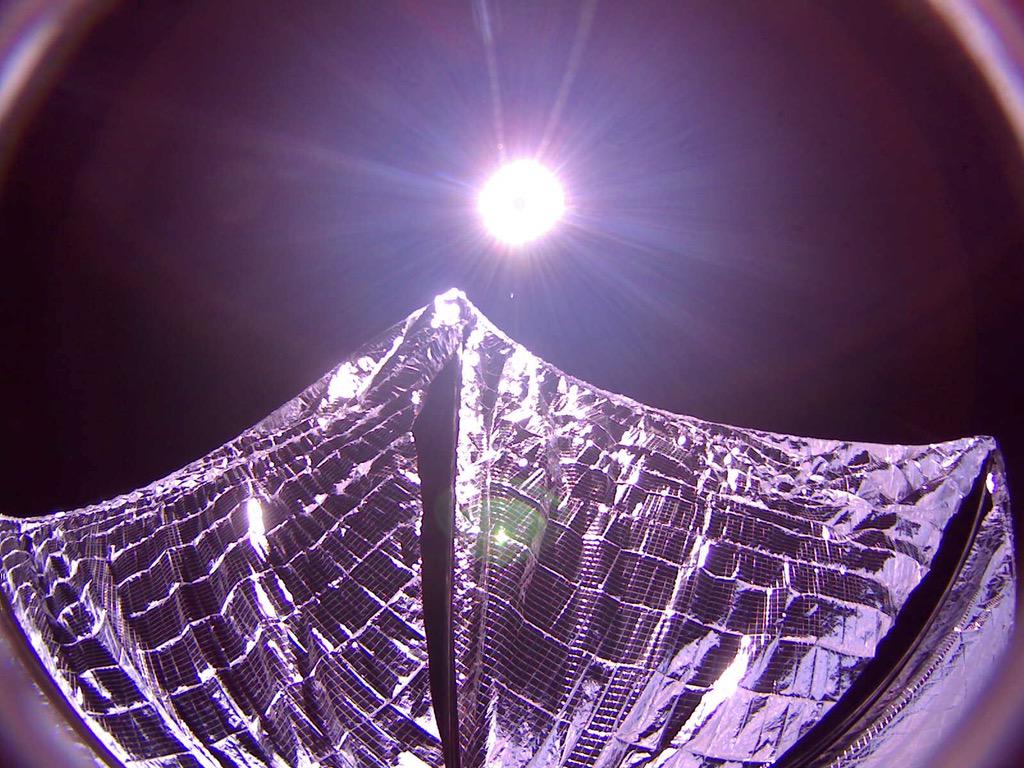
In a tweet Bill Nye The Science Guy describes this photo as "a complete image of #Light Sail in space! The future of space travel . . ."

This light sail launched on May 20 as a test, an early step toward the goal to "sail a spacecraft no bigger than a bread box, on beams of light," he said. "Imagine it: unlimited free energy from the Sun will provide CubeSats with propulsion and revolutionize access to space for low-cost citizen projects. This means that spacecraft, especially small ones like CubeSats, won't have to carry heavy fuels into orbit, and that the acceleration will be continuous."

Two days after launch a software glitch made the little satellite unable to deploy its sail. On May 31, contact was made and on June 3 the solar panels were deployed. June 4 communications were again lost, but on June 6 communications were restored sail deployment commenced on June 7. On June 10 photos (including the one above) were successfully downloaded as well as extensive data.

The original plan was for the satellite's orbit to degrade within two to ten days following sail deployment, and fall back to Earth, burning up on reentry. LightSail-A made its fiery reentry June 14, its mission a success.

In Murder on Ceres, my science fiction/murder mystery, the loss of a solar sail proves to be an important plot point.

"Solar Sail Sakurakaze with Mark A. Warner aboard unaccounted for. No contact. No request for assistance."

"Aptly named, the Sakurakaze looked like a sakura blossom. Its five sails extended radially in graceful curves, each with a notch in its distal end. The furled sails would open as she pulled away from the dock. Like a flower blooming."

Specs on Warner's solar sail read as follows:
"Four-passenger sport class Kono II with Stang auxiliary thrusters. It could reach more than ten times enough velocity to escape Low Ceres Orbit. Enough to escape Low Mars Orbit."

The Deuce was constructed of carbon composite to reduce over-all weight without sacrificing strength and durability, the cabin hung below the sails. The builder's description was pure promotion, "Its black exterior reminiscent of ancient Japanese lacquer ware. The interior finished in synthetic teak and white ceramic, for the warm look of wood and the classy simplicity of porcelain, while staying well within weight limitations."

The future is now.


Sunday, March 1, 2015

Leonard Nimoy and Star Trek -- An Essay

 image from xfinity.comcast.net
Leonard Nimoy
   March 26, 1931 -- February 27, 2015

This is a description of the world as I knew it when Star Trek and its cast came into my life. Leonard Nimoy’s death has given me an opportunity to think about how the world was then and how it’s changed.
I grew up White, Protestant, working class, in Oklahoma.
In 1966 I graduated from high school. Most of my close friends had graduated the year before and my college experiences started when they started college. With them I met Black people and gay people for the first time. “People” isn’t exactly the right word. I met one Black, lesbian woman. Her color was obvious. Her sexual orientation was not, but she neither hid it nor announced it.
And “for the first time” is wrong, too. I spent my first ten or eleven years in small Oklahoma towns where segregation was a part of life. The schools were being integrated one grade at a time beginning with the 12th grade and working its way down. The towns still had “white” schools and “colored” schools. “Colored” was considered the polite term by my parents. My grandparents used the “n” word. I don’t remember anyone using the word Negro, except the news people on TV. Our towns had one main street – two maybe three blocks long. Some of the stores served White people and some served Black people. I was never in a “colored” store. I’m sure there were Black people on the streets Saturdays, but I don’t remember them. I think kids are just like that. All people belong to one of two groups. They are either grown-ups or kids. And you don’t pay much attention to grown-ups unless they’re kin or authorities. And kids are kids. Color, religion, and language don’t much play into it.
There were very few Catholics, no Jews, no Asians, and no Hispanics. A few people spoke with accents mostly German accents, but they were grown-ups.
Before integration got to the grade I was in, we moved into the Oklahoma City School District which was segregated by residential practices. For those of you who don’t remember that, it means Blacks were not allowed by custom to live in White neighborhoods. No laws had to be enacted to enforce this type of segregation. The general White public did it, some tacitly, some aggressively.
We had one Japanese boy in our class. No other Asians, no Hispanics, and few Native Americans. (We called them “Indians.” We didn’t realize there were any kind of Indians other than Native Americans.) I had never eaten with chop sticks. I’d never eaten avocadoes. And my grandmother’s idea of spaghetti was spaghetti stewed with tomatoes and sugar served over mashed potatoes. Oregano was not in our lexicon. I did meet a Jewish girl at Girl Scout Camp the summer after the sixth grade.  
We were in a Cold War with the Soviet Union and we lived near Tinker Air Force Base. We all knew what number Tinker was on the Soviet hit list. We lived through the Cuban Missile Crisis. Magazines had recipes for Jell-O salad and instructions for building a bomb shelter.
When the Oklahoma City School District was ordered to begin busing to integrate its schools, we moved to a college town north of Oklahoma City. A White, college town. Only the college was integrated and that not very much. Still no Black students in the public schools.
It was then that the ugliness of segregation struck me. Because it affected a fellow high school student. He was a year ahead of me. He was bright and funny and kind. And while in The City (that’s what we called Oklahoma City) he was refused service at a lunch counter because they thought he was Black. His ancestors were Italian and he was a life guard at the local swimming pool so he was dark-skinned. Somehow, the fact that they treated him like he was Black when he wasn’t was not the injustice for me. It was the fact that his dark skin could be used against him. That the color of anyone’s skin could be used against them. That was the injustice.
By the time I was in college, I realized that injustice covered a much broader field than just skin color. My friends who didn’t go to college because of finances or academic indifference or legal entanglements were being sent to war. My friends who were gay were being threatened. Black and White people were being killed because they wanted to help Black people vote.
Then Star Trek hit the airwaves. I could see on my little black and white TV screen all kinds of people working together to explore and save the universe. There was a competent Black woman, a half-Vulcan/half-Human man. There was a Japanese guy and a Russian. A Russian good guy. And the combination of people was presented to us as common-place, normal.
We’re part way there. There have been great strides in civil rights in this country. In most places we can be friends with, work with, live next-door to, and marry whomever we choose. The Internet makes it possible to communicate across most borders without needing permission. And in Space, we have the International Space Station and her diversity-rich crews. There’s more to do. There’s always more to do. But we truly are “going where no man has gone before.”
I know that Leonard Nimoy was not Mr. Spock, but he gave life and legend to the character who approached reality rationally and scientifically. His character was treated with love and respect by the other characters showing how it could be among humans (and part-humans.)

Nimoy’s family will miss him, the man they knew. They will know on a daily basis that Leonard Nimoy is gone. But us fans? We’ll soon forget that he is gone, because we’ll continue to see him as we knew him – Spock. We’ll see him whenever we want to. Or whenever we happen to. And he’ll continue to say to us “Live long and prosper.”

image from metalinjection.net
Mr. Spock
September 1967 -- Into the Future


Tuesday, October 28, 2014

Imagination -- short essay

earth-mind from dreamstime.com

The mind is a wonderful thing. It invents everything – even things that can’t be. Or, at least things that the very same mind can’t make be.
I had a dream, a very strange dream.
Something happened to the earth. A cataclysm that shook and frightened my sleeping self. And my first clue that something big had happened was in the sky. The clouds swirled oddly. Into a sort of disc, white clouds with blue sky all around.
And a man rode a horse off the edge of the earth. And lived to tell the tale. (This was a dream, after all.) Then somehow I could see the earth from a distance and it was a series of discs with space between, stacked several high. Maybe five or six. I don’t know. I didn’t count them. I was asleep.
None of the discs was the interior of the earth, just the mantel. Quite pretty, actually – all shades of blue and brown and green.
Dreams are fine, sufficient within themselves. But this dream stayed with me as I was waking. And my waking mind immediately set out to discover how this dream could be real.
How could this possibly work? Gravity? How thick would each disc have to be to have enough gravity to stay that close together? To hold the atmosphere? Then there are questions about rotation, atmospheric circulation, distribution of solar heat to generate weather and those clouds that so conveniently formed a disc, too. Not to mention having enough soil to grow grass and trees and horses for men to ride off the edge.
Where are the physicists and cosmologists when you need them?

There’s the rub. Scientists use their imaginations to figure out how the universe works, not ways to make it work the way we imagine.