Showing posts with label science fiction. Show all posts

Thursday, April 27, 2017

U, V, and W -- Nonfiction


W Is for Writer 

I am a writer. I have one novel in print Murder on Ceres. It is available from Amazon as both a paper back and on Kindle. And I'm currently working on the next in what I plan to be a series of four.

At some point several years ago I decided to do what I've always wanted to do -- write a book.

Although my fiction reading is eclectic (some would say indiscriminate) my fiction goto's seem to be murder mysteries and hard science fiction. So I wrote a science fiction/murder mystery or maybe it's a murder mystery/science fiction like I would like to read. The story is set in the future when civilization is centered in the Mars colonies and Earth is truly the "old country" but humans are still humans and murder happens.


"Balancing the demands of his job and his responsibilities to his family, Rafe investigates the suspicious death of a Ceres Colony Consortium accountant. Suicide? Overdose? Homicide? Not his upcoming trip to Earth, not his independent and fiery wife, nothing will keep him from the case.

"Through a whirlwind of illicit drugs, space pirates, and secret identities, Detective Rafe Sirocco chases the truth all 266,000,000 miles from the shining cylinder of Ceres Colony to the alien landscapes of Earth. But will he make it in time to save the one person that matters to him most?"


My nonfiction reading is equally eclectic -- Stephen J. Gould, Neil deGrasse Tyson, Carl Sagan and Isaac Asimov (yes, they wrote nonfiction which I actually like better than their fiction.) David McCullough, Carl Sandburg (his Lincoln and his poetry,) Maya Angelou, Shel Silverstein, Dr. Seuss, etc., etc., etc.

If I had written a U-blog, it would have been about the Universe just because it is so beautiful and I could use pictures from the NASA/ESA Hubble telescope like this one.


Close-up of M27, the Dumbbell Nebula

Their name for this photo. Imagine calling this a "close-up."  It is more than 1,200 light-years away. A light year is the distance light can travel in one Earth year which is nearly 6 trillion miles. Now multiply that time 1,200 and this is a close-up.  This glorious display of color is the result of an old star that has shed its outer layers. Discovered by French astronomer Charles Messier in 1764, a dozen years before the Revolutionary War, it was the first planetary nebula discovered.

And had I done V-day, it could have been Voyager 1. On September 12, 2013, NASA and the Jet Propulsion Laboratory confirmed that Voyager 1 had indeed left our Solar System and entered interstellar space. Where is it today? Click here for a real-time odometer of Voyager 1's distance from the Earth and the Sun in astronomical units (AU) and kilometers (km).

Better yet, The Golden Record.


It is "a kind of time capsule, intended to communicate a story of our world to extraterrestrials. The Voyager message is carried by a phonograph record-a 12-inch gold-plated copper disk containing sounds and images selected to portray the diversity of life and culture on Earth."


#atozchallenge

Friday, April 21, 2017

Robinson, Kim Stanley -- a Science Fiction Writer


Mr. Robinson is identified by The New Yorker, "as one of the greatest living science-fiction writers." He was awarded the Hugo for two of his Mars trilogy books and a Nebula for the third in the trilogy. Plus two more Nebula awards and last year the Robert Heinlein Award for his whole body of work. Oh, my goodness!

And when did I hear about him? About a month ago during an interview he did with NPR. They didn't mention all those awards. (I only mentioned here the ones that mean the most to me. He's got quite a list of them.)

During the interview they described New York 2140 as focusing on the way realistic humans might deal with the world when sea levels rise 50 feet above their current levels and the major cities are and have been flooded for several generations. And they specifically said it is not an apocalyptic view of society.

So, of course, I got on line to my personal source of all things written -- my public library -- and reserved a copy.

The book is complex, peopled with characters from all walks of life. Regular life -- a police detective, a hedge fund operator, a building super, a couple of feral pre-teens, a government/NGO activist (read social worker) and an entertainment personality. Each of whom brings their own community connections. And, of course, some unknown, nefarious speculators intent on a hostile take over of the potentially lucrative intertidal real estate where our regular folk live.

Plus an anonymous citizen who explains the City of New York, its geography, a bit of its history, and its 2140 climatic conditions. All information, I as a non-New Yorker need and am interested in. Though, let me reassure you that it's not necessary that the reader recognize the City's particulars to follow the story.

The story is fairly simple. Climate change has done the inevitable, drowning the major coastal cities of the world with New York being our particular city of interest. American society and government has continued on it merry way meaning that income inequality has escalated and the people's income continues to determine the quality of life they lead and limit their political power. The amazing part to me, is that New York continues to be a people magnet, attracting people to live there in whatever condition they can afford despite its flooding, hostile weather, poor housing, etc.

The story draws us in as the characters work together to change their society to more successfully deal with what to them is New York's normal, if difficult, condition.

There is no lantern jawed hero scientist or bosomy damsel in distress. Well, maybe the entertainment personality, but that's not all there is to her.

I like the idea that a group of regular people can change the status quo and have a chance at making a better world, albeit a seriously flawed physical one.

And you can bet I'm going to be reading much more of Kim Stanley Robinson.


image from El Periódico

#atozchallenge

Sunday, December 4, 2016

Arrival -- Reprise


Arrival image from The Playlist

Didn't you just see a blog post from me reviewing this movie a couple of weeks ago? (http://bit.ly/2eQadud) You surely did!

I went to see it again. Today. And teared up in the same place. No, not because it was sad, but because it was so beautiful and hopeful.

I like it even better after having seen it a second time. This time I could watch it analytically. For its structure. The first viewing I got caught up in the story.

Arrival is complex. It questions our understanding of time. Must time be linear? Must it always flow forward? Is there another way to perceive time?

I took my daughter and her fiancé with me then out to lunch. Grace saw the movie with me the first time I saw it. Bob did not. So during the 'post-movie quiz' I could question him as a newby. When did he realize what was happening? Were the interspersed scenes with her daughter flashbacks or foresight? Did her understanding of the aliens' language change the way she could perceive time?

What new discoveries had Grace and I made during our second journey through the movie?

I don't buy many movies. Heck, I don't even go to the movies very often. But I'm gonna buy this one as soon as it becomes available.

Sunday, November 13, 2016

Arrival -- A Review

image from Wikipedia


I love Science Fiction in books. In movies, I like Science Fantasy. With Star Trek and Star Wars in the movies, you don't have to worry about the science, because they're fantasy. And their violence doesn't disturb me. I love the flash-bang of those movies as much as anybody. I guess because it doesn't seem real. (See my reviews "Star Wars!" from January http://bit.ly/1VbH7VF and "Star Trek Beyond" from July http://bit.ly/2acaJ5w)

Science Fiction in the movies, on the other hand, is often problematic. They just simply too often get the science wrong. A recent example of that was The Martian. (See my review from October, 2015 http://bit.ly/1QmsE73)

Arrival which opened here in the Denver area Friday gets it right. I heard a review on NPR that described the movie as "furiously intelligent." Okay, so furiously is an odd choice of adverb to modify intelligent. But, hey, it got my attention. The reviewer went on to say that the hero of the piece is a professor of linguistics. Now, I'm interested. Throw in the sentence "Carl Sagan would be proud" and I'm hooked.

So I make arrangements to go to the movies with my favorite movie companion, my daughter Grace.

As you know, this has been a rough week for me what with the election debacle. I began to worry about the movie. I hate it when Hollywood blows Science Fiction. The reviewer described the aliens in Arrival as "leggy insectoids."

I pointed out to Grace that the aliens couldn't be very big, because an exoskeletal creature of much size couldn't stand up to Earth's gravity. And I didn't think I could stand it if the whole thing devolved into a chase scene shoot 'em up like so many Hollywood products. She suggested that I shouldn't be looking for things to be wrong before we even got to the theater.

The movie is eerily reminiscent of 9/11. It starts out on a very ordinary, sunshiny day as Dr. Louise Banks (Amy Adams) crosses her college campus. The students out and about, seem unusually distracted by their phones. When she gets to her classroom, she notes how few students are there, but begins her lecture anyway. The cell phones in the room start going off and the students answer them. Finally a student asks her to turn on the television to get some news.

We didn't all have cell phones when 9/11 happened, but classes everywhere were interrupted by people turning on televisions to get some news.

In the movie UFOs have arrived at points scattered around the Earth -- Shanghai, two locations over Russia, Italy, Montana, etc. Maintaining her sense of rationality, she quietly waits for a bit in the parking lot before joining the chaotic exodus away from the school. This attention to detail and the very realistic reactions to such unusual news gets us off to a good start.

Colonel Weber (Forest Whitaker) for whom she'd done some translations before shows up and requests her help translating the aliens' language. He is terse and to the point throughout.

Weber -- a name valued in my family -- teams Louise with physicist Dr. Ian Donnelly (Jeremy Renner.) I like Donnelly. The writer got him right. He is appropriately geeky complete with him protecting his mathematics turf.

The first hint that this movie was not going to be the usual Hollywood cock-up came when our heroes boarded a helicopter and they didn't all duck.

Then on their way to their first contact, Drs. Banks and Connelly experience the altered gravitation of the aliens' space pod. Insectoids dealing with Earth's gravity -- solved. As it turns out they're not "insectoid" at all. They're more a variety of cephalopod. But, whatever. Earth's gravity would still have been a problem unless the creatures were buoyed in water.

Scenes of Dr. Banks' lost child and failed marriage appear in, around, and among scenes of emerging American attempts at intergalactic diplomacy. For once, humanity's response is not shoot first and ask questions later. Of course as the story moves on, other governments around the world are not so forward thinking and begin to opt for war thus tipping the U.S. to do the same thing.

I won't give away the ending, but I will tell you I'm revising my opinion of Hollywood upward. And Arrival has revived my hope for the world.

Thursday, July 28, 2016

Star Trek Beyond -- A Review

Star Trek! 

Let me just start this review with what they did right.

James Tiberius Kirk played by Chris Pine -- a little preachy, a lot earnest -- check.

Spock, Zachary Quinto -- quite attractive, appropriately serious, just a dash of delightful naivete, maybe a shade too much emotion but then he's romantically involved in this film -- I'll give him a Yes!

Uniforms -- also a Yes! A bit Michael Jackson if he'd ever worn denim and I did question those chain-suspendery things. Looked too much like really big, beer can pop tops. But hey, I'm into repurposing as much as anybody.

Makeup -- Excellent. The new girl especially.


Sofia Boutella plays Jaylah, a brash, competent, beautiful alien who has the coolest special effects in the film. She does this hologram-multiplication trick that is spectacular.
  And the bad guy, Idris Elba as Krall. I like the little LEDs along his ridges.


The opening scene gets a Yes! Captain Kirk is presenting what he thinks is a precious symbol of peace, a gift to the gargoyle-ish Teenaxi from their arch enemies the Fenopians. It's a typical Kirk scene. It reminded both my husband and me of our bad cat Kocka.

(For those of you who don't know about Kocka, he's a fluffy grey cat who's more than a little prickly. I have scars.)

And the space station Yorktown is bright and beautiful which is exactly how I imagine the future to be.

I've been a dedicated Star Trek fan since Gene Roddenberry took us on that first five-year mission of the Star Ship Enterprise into Space, the final frontier to explore new worlds, to seek out new life and new civilizations, to boldly go where no man has gone before. (Can't you hear the music welling in the background?)

That was in 1966. The shows were filled with humor and new ideas and people and creatures who didn't look like everybody else on TV.

The wit and wisdom has been replaced by shock and awe. Where we used to have characters with dialogue, they give us explosions and the tinkling of broken glass. So, okay, I like 3D. I like XD. I like flashing lights and loud noises. I mean I've been to a Jefferson Starship concert where I could hold my hands against my chest and FEEL the music. My ears rang for days.

But Good Grief! Enough is enough. And the celebration of modern movie technological marvels should not replace wit and wisdom. I mean the best lines were from Scotty, played by Simon Pegg -- not surprisingly one of the screen writers.

I love science fiction. I write science fiction. Check out Murder on Ceres.

But this is the last Star Trek movie I'll spend my time on. I actually fell asleep watching it. How could it be so boring with all that noise and bother?

Maybe I have entered my curmudgeon-hood. Now "Get off my lawn!"

Monday, October 12, 2015

The Martian -- a movie review


image from wallpapershome.com

My husband and I went to the movies this afternoon. We saw "The Martian." To see it regular would be $5.15 per ticket, 3D $8.15, and 3D XD $15.15. We opted for the plain 3D, 'cause I like 3D but not $10 worth.

There are two kinds of science fiction -- hard science fiction and soft science fiction. Hard science fiction emphasizes scientific and technical possibilities consistent with our current understanding of science and technology. Soft science fiction plays fast and loose with the science. That leaves it free to tell whatever story it wants.

I love science fiction movies where the movie makes no pretense to serious science. The Star Wars and Star Trek franchises come to mind. They're exciting, visually stunning, and explore themes of universal human interest.

I write hard science fiction -- Murder on Ceres. It's available as a paper back and on Kindle. Check it out.

I would love to see science fiction movies that explore real possibilities. Stories that stay within the realm of scientific and technological possibility. We live in an age when we should be able to see movies like that. We really will be sending astronauts to Mars. The science is available. It is not beyond the normal human being's capacity to understand. And it is more amazing and thought provoking than the misrepresentations presented in "The Martian."

I guess that gives away my rating on this movie. I give it a 57 1/2 because you can dance to it.

Let me tell you what I liked about the movie first. Then you can stop reading if you don't want to know what I didn't like about it.

What I did like:
The visuals -- especially the Mars scapes. Broad empty land with dramatic rock formations. Reds and ambers, The deep blackness of space sprinkled with stars. They did distance very well. I liked the vehicles, too. (At least before the modifications which can only be described as dumb. Think visqueen and duct tape. Seriously? Seriously!)

Sorry. I was going to do the positive stuff first.

I loved the spaceship Hermes. Matt Damon does a good job acting. And Benedict Wong represents the JPL well. I always like JPL being mentioned whether in the news or movies. And NASA is my favorite government agency.

You know what? I'm not going to rant about the lights inside their helmets -- you already know how hard it is to see out of a car at night if the dome light is on. And surgical staplers don't sound like staple guns. And jumping up and down on a roof at Earth gravity does not equate to jumping up and down on a vehicle's roof at Mars gravity. (Mars gravity is 0.38 of standard Earth gravity. So a 185 pound Matt Damon on Mars would weigh 70.3 pounds -- not quite as much weight to throw around.) And hydrogen doesn't burn yellow.

But it makes sense that you could grow potatoes the way they do in the movie. And the movie does seem as long as it would actually take to travel to and from Mars.

I restrained my urge to laugh until the last ridiculous stunt. I mean with broken ribs? Come on.

But then when the movie was finally over, my husband took me to Barnes and Noble where I had a lovely cappuccino and chocolate mousse in their Starbucks. 

And I eagerly anticipate the next Star Wars movie.


Wednesday, June 17, 2015

Science and Science Fiction

Embedded image permalink
Photo from June 9 tweet by Bill Nye 
CEO of the Planetary Society

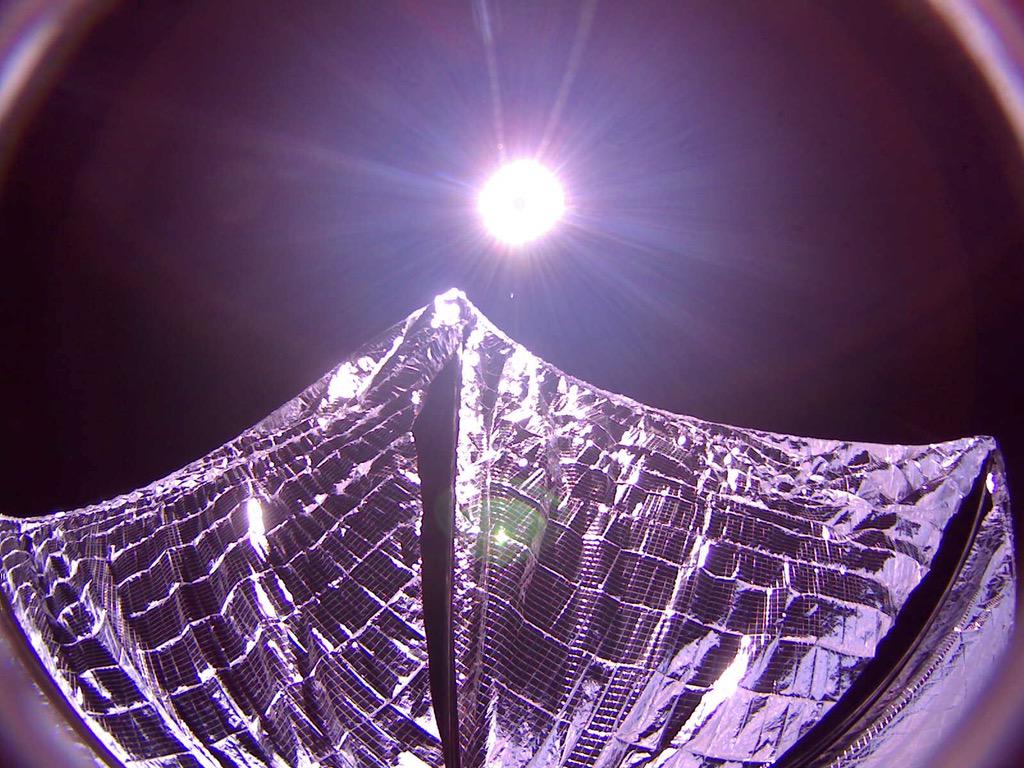
In a tweet Bill Nye The Science Guy describes this photo as "a complete image of #Light Sail in space! The future of space travel . . ."

This light sail launched on May 20 as a test, an early step toward the goal to "sail a spacecraft no bigger than a bread box, on beams of light," he said. "Imagine it: unlimited free energy from the Sun will provide CubeSats with propulsion and revolutionize access to space for low-cost citizen projects. This means that spacecraft, especially small ones like CubeSats, won't have to carry heavy fuels into orbit, and that the acceleration will be continuous."

Two days after launch a software glitch made the little satellite unable to deploy its sail. On May 31, contact was made and on June 3 the solar panels were deployed. June 4 communications were again lost, but on June 6 communications were restored sail deployment commenced on June 7. On June 10 photos (including the one above) were successfully downloaded as well as extensive data.

The original plan was for the satellite's orbit to degrade within two to ten days following sail deployment, and fall back to Earth, burning up on reentry. LightSail-A made its fiery reentry June 14, its mission a success.

In Murder on Ceres, my science fiction/murder mystery, the loss of a solar sail proves to be an important plot point.

"Solar Sail Sakurakaze with Mark A. Warner aboard unaccounted for. No contact. No request for assistance."

"Aptly named, the Sakurakaze looked like a sakura blossom. Its five sails extended radially in graceful curves, each with a notch in its distal end. The furled sails would open as she pulled away from the dock. Like a flower blooming."

Specs on Warner's solar sail read as follows:
"Four-passenger sport class Kono II with Stang auxiliary thrusters. It could reach more than ten times enough velocity to escape Low Ceres Orbit. Enough to escape Low Mars Orbit."

The Deuce was constructed of carbon composite to reduce over-all weight without sacrificing strength and durability, the cabin hung below the sails. The builder's description was pure promotion, "Its black exterior reminiscent of ancient Japanese lacquer ware. The interior finished in synthetic teak and white ceramic, for the warm look of wood and the classy simplicity of porcelain, while staying well within weight limitations."

The future is now.


Thursday, April 23, 2015

T is for Terren -- Excerpts from Murder on Ceres


On Day R we were introduced to Rafe, the protagonist in Murder on Ceres. Terren is his wife, a very important part of his life and his story. He introduces her in the first chapter.

She stood at the cook table, its malleable surface formed into a griddle. Even if she wasn’t a cook like his mother, he liked to give her the latest and best. He wrapped his arms around her from behind and nuzzled her dark curls. Her hair smelled of citrus and spice. She snuggled against him and turned the bacon.  His hands slid across her white silk kimono, smooth and soft like her skin. Her stomach still flat. No change with the baby. Too early.

“How about Cynthia?”  He suggested the name as he reached for a slice of bacon.

She smacked him with her cooking sticks and spun to face him. “Have you washed?”

“I love you.” He pretended innocence, making a second attempt at the bacon. “You are so pretty pregnant.”

“Cynthia? Certainly not, Rafael Sirocco. What if the poor baby has a lisp?” She threatened him with the cooking sticks.

Thinthia Thirocco…” He mused, curling the ends of his mustache.

With his left hand, he caressed her bottom. She relented and kissed him. With his right hand, he snatched a piece of bacon and was out of the kitchen before she could catch him.


[Here Terren is visiting an old family friend and the plot thickens.]

She sat on the rug and felt like a little girl again. She traced the red zigzags of lightning that framed a stylized cornstalk on the rug’s blue field. Perhaps they grow corn in the ground in Denver District.

Floor-to-ceiling shelves lined two walls, filled with old-style books. Different sizes and colors shelved in no order that she could see. How could anyone find a particular volume?

Her mom always warned her. “Don’t ask. Any book you want to read, you can download. You won’t lose it or damage it.”

And her father would say, “Unlike real estate, they ain’t making any more of them.”

They’d been right. But she couldn’t say she appreciated it. Still, even without them there, she didn’t touch. Looking was enough.

The gate bell rang as Mark came downstairs. He spoke with Watson a moment then excused himself. A door banged open. Raised voices echoed down the hall. She set her cup down.

A man’s voice, taut with emotion. “No, I don’t want your damn money.”

“Leave now.” Mark sounded angry. Then in a more composed tone he said, “We need to be reasonable, work this out. We’ll talk later.”

“All you do is talk.” The man lowered his voice which sounded somehow more menacing. “This was your deal. You clean it up yourself.”

The closer she got to the entry hall and the confrontation, the slower she moved, not sure she wanted to see what was happening.


[Then we find her in Ceres’s Commercial Passenger Transfer Station leaving for the alien planet Earth.]

At zero g, surrounded by flashing lights and movement, her stomach rebelled.

The navigation rails into Outbound Security provided a sense of stability. Things could be worse. Head up. Eyes forward. Breathe normally. In. Out.

She handed her mobile to the security tech and passed through a scanner. She wondered what exactly they were scanning for. Weapons perhaps? Stolen diamonds and emeralds and rubies? She glanced at the ring on her little finger. Mark’s ring.

The tech held a small screen in front of her face and instructed her to look at the dot. He compared the retinal scan with her ID. Satisfied that she was who she was supposed to be, the tech confirmed her boarding pass, ticked the box next to Earth, and entered his own ID code. He returned her phone and directed her to the door marked Outbound Ferry.

As she waited, she watched people moving through the inbound side of the partition. New arrivals were scanned for identity, contraband, and illness. Tighter security met those arriving. Without the vaccinations she’d taken in the past six weeks, she wouldn’t be allowed back onto the Colony without enduring a two-week quarantine.

Watching the authorities screen arrivals made her stomach clench with fear. Where she was going, there were things that Cererians must be protected from. Diseases Cererians did not need to vaccinate against. Diseases that had no vaccines. “Perhaps dragons do be there.” She spoke under her breath, not intending to be heard.

“Frightening, isn’t it?” A tall dark-haired man with a well-trimmed beard said. “What the government thinks we need to be protected from.” He also waited.

“Sometimes they’re right.” Her voice was husky. She turned her face away, afraid her tears might show.


All too soon, the reader discovers things the government couldn’t protect her from. Available in paper back or on Kindle from Amazon, Murder on Ceres

Wednesday, April 22, 2015

S is for Sci-Fi/Murder Mystery


My first novel, Murder on Ceres, is a Science Fiction/Murder Mystery. “Why couldn’t you tell the same story on Earth, present day,” asked my writing teacher, William Bernhardt. (Please don’t judge Bill by my writing prowess. He is a much better teacher than I am student.) He has a habit of asking me hard questions. And I have a habit of getting defensive before I think about the answers to those hard questions.

But I do think about them. And why write my murder mystery as science fiction? That answer is “Because.”

Because I like murder mysteries. I like them as puzzles. They are all puzzles. Some are more puzzle than anything else.

John Lescroat adds the enticement of characters I would like to know personally. His characters age and change and grow from one book to the next in his series. (Plural – I tried ‘serieses’ and Word didn’t like it so I looked it up. The plural of series is series, just like deer is deer.)

Some mystery writers take me places in a way that makes me feel like I’ve been there. I’ve seen Venice, Italy, through Donna Leon’s Commissario Brunetti’s eyes. And I’ve visited many of the National Parks while following Nevada Barr’s Anna Pigeon who is a Park Ranger and apparently gets transferred a lot. Luckily for us readers.

Diane Mott Davidson has the murder mystery puzzle plus identifiable characters plus good recipes. And I like to bake.

When I was deciding what kind of murder mystery I wanted to write, I knew I wanted to follow a set of characters as they grow and age. That I can do. I like the idea of an exotic setting. As much as I love Oklahoma, Arkansas, Louisiana, and Texas, those are the only locations I’m familiar enough with to write about. None of them seem very exotic to me. And I didn’t write recipes. I have family members who will tell you that I don’t even follow recipes very well.

So the search was on. What else did I like to read? Of course there were literary writers like John Irving and Margaret Atwood. Now I may have illusions of grandeur on occasion, but that is just not gonna happen.

And because I love Isaac Asimov and Carl Sagan. I love their nonfiction even more than their fiction.
They inspire imagination. What will it be like to live off-planet, to emigrate from Earth to colonies scattered through the Solar System? How will humans be different? How the same? What will their everyday lives be like? Their problems? Their solutions? What will they call their washing machines?

These are subjects that could keep me interested enough, long enough to write a novel. And, in fact, these things are keeping me interested enough to get me well into my second novel. With concepts bubbling on the back burner for at least two more.


What I want to write are books I’d like to read. With my Sci-Fi/Murder Mystery crossover, I can develop my characters realistically in about as exotic a location as possible. And I believe readers will enjoy thinking about how things will be as much as I do.

Friday, April 3, 2015

Character Building -- An Essay


While I went about my daily business after posting yesterday’s “Briers and Brambles,” I couldn’t get the character out of my mind.
I often write flash fiction to practice some aspect of writing – world building, dialog, scene setting. Rather like an artist does studies of hands or ears or faces.
Yesterday was an exercise in tension building. At least that was the intent. As it turns out, there was the beginning of a character in that piece. A character that I think I’m going to like. At first I thought she’d make a great protagonist for a detective novel. Maybe a whole series of novels. Do I sound like a writer or what?
She was alive in today’s world. But I don’t write in today’s world. I write sci-fi/murder mysteries. I built my world in Murder on Ceres. It’s fully populated with characters I find interesting and satisfying. Dead and Gone is my next novel, currently a work in progress, as they say. It has the same characters in the same world. I didn’t need another character. There’s a new antagonist, but considering what happened to the antagonist in Murder on Ceres, that’s to be expected. 
So I put this woman out of mind. After all, I had important real world activities to perform – dishes to wash, appointments to schedule, an expired auto license plate to renew.
But she wouldn’t go away. So I'm giving her a chance to adjust to my world. She’ll have to move to the Denver Region and to the future where civilization is centered in shiny metal cylinders orbiting Mars. Can she give up her attachment to the Colt 45 Automatic, Model 1911? She’s just old fashioned. But is she too old fashioned?
Any new character sends me back to the basics I learned from William Bernhardt. He writes thrillers and other things. Most importantly for me, he teaches and he’s written The Red Sneaker Writers Book Series. And more particularly, Creating Character: Bringing Your Story to Life. (Available from Amazon. Click here.)
Its Appendix A: Character Detail Sheet is a revelatory exercise. I’ve learned that my new character was born on Earth; her name is Madeleine Denise – a name she hates; she’s generally brown like most people on Earth at this time; she doesn’t suffer fools; and she’s a damn good cop.
Look out Joe and Rafe and Terren. There’s a new character on the block.


Friday, August 2, 2013

Blog Hop


Thanks to Grace Wagner for tagging me.

1:  What is the working title of your book?
Murder on Ceres

2: Where did the idea come from for the book?
My favorite genres are mystery and science fiction. Diane Mott Davidson’s mysteries were my especial favorites. Her characters are believable and engaging. Her violence is done almost gently. For science fiction, I am drawn to Isaac Asimov. He provides believable, thought-provoking science.
I wanted to present humans as I think they are likely to be no matter the technological advances of the future. I want my characters to be accepted as real people by the reader. And I want my characters to realistically live in what is to them the normal universe.

3: What genre does your book come under?
Murder on Ceres is a natural cross-over, a traditional mystery set in the future.

4: Which actors would you choose to play your characters in a movie rendition?
I’ve never thought of my characters as being like this or that actor. I will leave that up to the movie people, should it ever come to that.
No doubt, Rafe as the hero will be young and handsome; Terren as his wife will be tall and beautiful; Joe, the sidekick, will be older and ruggedly attractive. Mark, the antagonist, will be mature and charming. TePaki, the pirate will be tattooed and threatening.

5: What is the one-sentence synopsis of your book?
In a time when Mars is the center of humanity and Earth is literally the Old World, humans will still be humans and murder happens.

6: Is your book self-published, published by an independent publisher, or represented by an agent?
I am seeking an agent.

7: How long did it take you to write the first draft of your manuscript?
Almost three years.

8: What other books would you compare this story to within your genre?
Vernor Vinge’s Rainbow’s End successfully marries science and character. His people seem perfectly normal and live normally in their very different world.

9: Who or what inspired you to write this book?
Carl Sagan is the who.
“Exploration is in our nature. We began as wanderers, and we are wanderers still. We have lingered long enough on the shores of the cosmic ocean. We are ready at last to set sail for the stars.” Cosmos
I believe out-migration from Earth is the inevitable and necessary next step for our species.

10: What else about your book might pique the reader’s interest?
Our hero must solve a murder and bring the murderer or murderers to justice. He must survive professional and personal disasters, some natural and some man-made, from the lovely pearl that is the asteroid Ceres through the vastness of space to the beautiful blue marble that is Earth.


Tagging more Writers:
This I cannot do without permission. So if you are interested in joining in, give me a shout and we’ll do it.