Friday, August 14, 2015

Writing Contest


They're gone! My entries for the annual Rose State Writer's Short Course competition are in the mail.

No more editing. No more rewrites. No more thinking and rethinking. Questioning, doubting, second-guessing.

"Heroes," my entry for Flash Fiction is my absolute favorite. It is my way of honoring all those mothers out there who allowed their children to do dangerous things because those things needed to be done. Like my friend Allegra's grandmother who let Allegra's mother take part in the lunch counter sit-ins in Oklahoma City in the late 50's and early 60's.

Flash Fiction is almost poetry. It must tell a whole story in two or fewer pages. That means the writer must use the absolutely, most evocative, right word -- Hemingway's mot juste. The writer must engage the reader's experiences, their sensory memories, their fears, their dreams, and their hopes. And, most importantly, the writer must trust the reader to be willing and able to participate as an involved reader.

"Dead Birds and Broken Bottles," is creative nonfiction -- a new field for me. The trick to creative nonfiction is that it has to be true. Somehow my personal experiences have just never seemed exciting enough or well-plotted without embellishment. Or they were too personal and I was not comfortable being a character in my own story. Or somebody would get their feelings hurt and get mad at me. It wouldn't be safe to accidentally meet them at the local Walmart.

Everyone, no matter where they live, has a weather or natural disaster story. And being from Oklahoma, tornadoes lend a certain excitement to my own memories. Living in a small town offers all kinds of interesting characters. So I had the excitement and the familiar characters for a nonfiction piece. Then the creative part was to turn the factual time-line into a plot.

This particular tornado happened more than half a century ago so most of the characters are dead now and not likely to show up at Walmart. I'm feeling relatively safe in that respect.

Then there's "The Girl in the Reeds." Those of you who know me, know that I am particularly fond of mysteries. Murder mysteries.

Because I am currently working on a follow-up novel to Murder on Ceres, a Science Fiction/Murder Mystery, I didn't want to take time away from it to spend days and weeks on a murder mystery for this competition. I decided to write a murder mystery short story.

Keeping in mind that Murder on Ceres started out as a short story, this was a dangerous undertaking. I didn't know if I could write a mystery in short story form. Short stories are generally 7,500 or fewer words. I'd written short stories before, but not murder mysteries. The question was could I construct an interesting puzzle and solve it within that number of words.

And, you know what? I did. (Here insert a vision of a white-haired sexagenarian doing a happy dance, whilst humming the Theme from Rocky.)

I am excited. I am pumped. Look out, Oklahoma. I'm on my way!


Monday, August 10, 2015

Everything Matters


image from lynnaustin.org

When you write, everything matters.

I just finished – and that’s the wrong word – three pieces to submit to the RoseState Writing Short Course competition. Dead Birds and Broken Bottles for nonfiction. The Girl in the Reeds for short fiction, and Heroes for flash fiction.

What? No poetry? No. No poetry. My poetry days are past and gone, though I did love it. The flash-bang of the one perfect word. The staccato repetition of a sound. The flood of thought or feeling that can immerse you in a line.

But, like Hemmingway, I still labor over the mot juste. The perfect word.

In Heroes the main character Charlotte has forbidden her daughter to go to a sit-in. The child argues, whines, and wheedles. As children are wont to do. At one point I said Charlotte ‘sighed.’ BUT – as I was getting into bed, I realized ‘sighed’ is the wrong word. It gives the impression, the feeling that she is capitulating to the child which is not what I meant at all. She is NOT capitulating. Indeed, she is actively making a choice to JOIN IN, to support, to participate. Rewrite!

I stopped writing The Girl in the Reeds when I got to the end of the story. This is the first murder mystery short story I’ve ever successfully written. There’ve been many short stories, but never a murder mystery short story. Short stories are by their nature, short. And I never thought I could build a puzzle and solve it in so short a space of time.

(Murder on Ceres was originally intended to be a short story but, like Harriet Beecher Stowe’s Topsy, it just “grow’d.” Until now it’s well on its way to being Dead and Gone, the second in a series of novels.)

Even so, with The Girl in the Reeds, I quit too soon. But it was truly a ‘short’ story. The action was over, the story told. All were safe and sound, at least from this mystery. But the ending did not satisfy. Like a wonderful meal. You’ve eaten. The food was good. The service, too. The ambiance pleasant. You could linger for hours, but you’ve got a life and you’ve got to go. Now you’re presented with the bill. And a chocolate covered mint.

I’d left out the after dinner mint. Rewrite!

And Dead Birds? It was the title. Originally I just called the piece Tornado. My editor didn’t like it. Too simple. Won’t catch the reader. Needs to be more.

The only thing bigger and scarier than a tornado would be a hurricane. Right? But my piece of nonfiction is about a tornado. So why would I call it Hurricane? Enough said. She, who wields a red pen as though it were a rapier. Nay! A broad sword. She said, “Think about it.” Rewrite!


And speaking of titles – this blog post is titled “Everything Matters.” Even I can plainly see it should be called “Rewrite!”

Saturday, August 8, 2015

Red Rocks -- A Day Trip

July 27, 2015
from center front clockwise: Silas, John Riley, Sonja,
and John Ryan
That's my son, his lovely wife, and their two brilliant sons. They live in Texas, so they particularly enjoyed our relatively mild mid-day temps. Their daughter was in Alabama for a mission trip. We missed her, but maybe she can come up later this year.

Red Rocks was 'discovered' in 1820 by a U.S. Army expedition. (The Ute apparently knew it was here long before that.) The Beatles played Red Rocks 51 years ago this month on their first American tour. And, after living 6.5 miles from it for almost four years, we've added it to our list of favorite day-trips. 

Running the steps in the amphitheater is a popular pastime with the locals. I make do with hiking the trails and taking too many photos.

And maybe sometime soon I'll add it to night trips. (Movies on the Rocks--live music, a comedian, and a classic movie. All for $12. BYOP--Bring Your Own Picnic.) 


The Rocky Mountains are primarily granite,    but scattered about in Colorado are magnificent  outcroppings of sandstone, testifying to the area's ancient history as a great inland sea.


And yes the sky is exactly this blue. 
Because we are in the rain shadow of the Rockies, our climate is that of a high plains desert.
And our native flora are often as architectural as the mountains. 
This is Common Mullein and, although it was the
end of July, it was not yet in bloom. That tall, leafless bit
at the top boasts brilliant yellow blooms now.

Many of our other wildflowers were showing the wear and tear of our fierce sun
and sporadic rainfall.

Pineywoods Geranium                              Toadflax                                     Dwarf Golden Aster

This year is being considered a 'wet' year. Keep in mind, however, that even during our wet years we measure rainfall in fractions of an inch and rain events rarely last longer that 20 or 30 minutes. 

While we were in the park we met a young man from Illinois. I explained about our arcane water laws. By interstate compacts with our downstream U.S.neighbors and international treaties with Mexico, we may keep only one-third of the water that falls on Colorado. It is illegal to catch and hold rain water that falls on our property. It is illegal to dig a water well without permission. That water is all spoken for.

And, this year in particular, our neighbors in Utah, Arizona, California, and Northern Mexico are in particular need. The young man from Illinois could not understand. When it comes to water, his home state is a land of plenty. The Southwest United States is not.

This is as close to lush as we come,

and we love it.


Sunday, July 19, 2015

Manner of Death and Means of Murder


Lone Star Tick Image from
dailynewsdig.com

“Death by misadventure,” a phrase describing manner of death catches my ear and stimulates my imagination. “Unintended consequences” does too. Both spring from the concept of “accident” but imply some sort of human intent, though not necessarily “good” intent or “well considered” intent.

The idea of someone meriting a Darwin Award by bumbling into their own death does not make for a good murder mystery, in my opinion. However, if a third party bumbles into someone’s death while that third party is involved in some nefarious activity – now I’m interested. Or if the dead person colluded in the crime. Or some other crime.

If the dead person were an innocent, and the murderer a jealous lover or crooked business partner or a crazed serial killer, the story very well may not be a mystery at all, but a news story. And those stories can and do inspire murder mystery writers.

All murder mystery writers understand that the most dangerous animal in the woods is homo sapiens sapiens – modern humans. Naturally, the fact that most murder mystery readers are modern humans makes them inordinately interested in what their confreres do or have done to them.

As to “means of murder.”

Agatha Christie was particularly fond of poison. Check out the Agatha Christie section of Torre Abbey Gardens in her hometown of Torquey, England. (May have to add Torquey to my Bucket List.) John LesCroart’s The First Law uses guns – up to and including a major shoot-out. (Maybe I should put San Francisco on the Bucket List.) Nevada Barr in Ill Wind takes advantage of a geologic peculiarity. (Definitely should put Mesa Verde on the ole Bucket List. It’s a lot closer to my house.)

My husband’s education and a lot of his professional experience is in the field of Veterinary Medicine. He says “The most dangerous animal in the woods, after man, is the tick.” Just imagine a man with a tick.

What an intriguing thought. Ticks, as described in Wikipedia, will make your blood run cold and reach for the DEET. And that’s just reading about them.

They have eight legs like their arachnid relatives, spiders and mites. They meet all their nutritional needs by sucking blood. They can carry disease-causing bacteria, viruses, and protozoa. Indeed, they can carry more than one pathogen at the same time making diagnosis and treatment more difficult.

In far southeast Arkansas, where we had a veterinary clinic, my husband provided blood samples from our patients with ehrlichiosis to Dr. Sidney Ewing at Oklahoma State University School of Veterinary Medicine. Ehrlichiosis is caused by members of the genus Ehrlichia, a genus of bacteria named for the German microbiologist Paul Ehrlich. One of those little beasties is Ehrlichia Ewingii, named for OSU's Dr. Ewing. (Rather a perverse honor, I think – having a disease causing agent named for you.)

Ehrlichiosis in dogs and humans has long been successfully treated with Doxycycline but some of our cases were proving to be drug resistant. And untreated or unsuccessfully treated, the disease is lethal.

The important thing in treating any tick-borne disease is beginning treatment immediately which requires early diagnosis or at least awareness that the sufferer has been exposed to a tick so treatment can be started. 

Just think, if the intended victim had not been in the woods – maybe did not even live in an area known to be a tick-bite risk area . . . .

The murderer could acquire the ticks elsewhere. Overnight by UPS then give the little buggers easy access to a blood source to keep them alive – say a mouse the murderer is not particularly fond of. And then access to the victim -- say in the hair behind the ear.


The local medics wouldn’t know to ask about recent tick bites or look for ehrlichia or promptly start proper treatment. Voila – Murder by Tick.

Monday, July 13, 2015

Green Mountain -- a travelogue


My Green Mountain.

That’s how I always refer to it. It’s two miles from our house, but it’s recognizable from almost any place in the Denver area because unlike the rest of the foothills it has a bald, rounded top. So whether I’m at the Museum of Nature and Science down in Denver or the Woodcraft store south of Denver in the town of Centennial, I know which way is home.

This picture was taken May 10, 2015, Mother’s Day. That was our last snow of the 2014-15 winter season. In this picture, weather is coming out of the mountains, obscuring the taller foothills behind Green Mountain and the Front Range 14ers behind them.

We moved to Denver almost four years ago from Edmond, Oklahoma. I had never been interested in exercise or hiking. In Oklahoma if you can't get there in a car, why go? The weather there is not conducive to outdoor activities in the summer -- too hot. Or the winter -- too cold. And there are few sidewalks or walking or biking trails in or near urban areas. They're changing though.

In Lakewood, which is our town, there are bike lanes and sidewalks and trails in the parks and open spaces. Green Mountain is in William F. Hayden Park.

Denver is located at altitude 5,280 feet. Our house is at 5,700 feet and Green Mountain’s summit is at 6,854 feet.

I’ve hiked to Green Mountain's summit and I’ve walked its shoulders in every season. It’s always beautiful – sometimes white with snow, sometimes brown and brittle. This spring and summer it fits its name, green.

                      
           This is my favorite starting point the Utah                   This is my daughter Grace 
           Street Trail Head. No motorized vehicles                     heading west up the trail. In 
           are allowed on the trails, but bicycles are                     that direction, as you can see,           welcome as are horses and hikers.                                the sky was a brilliant blue.                    

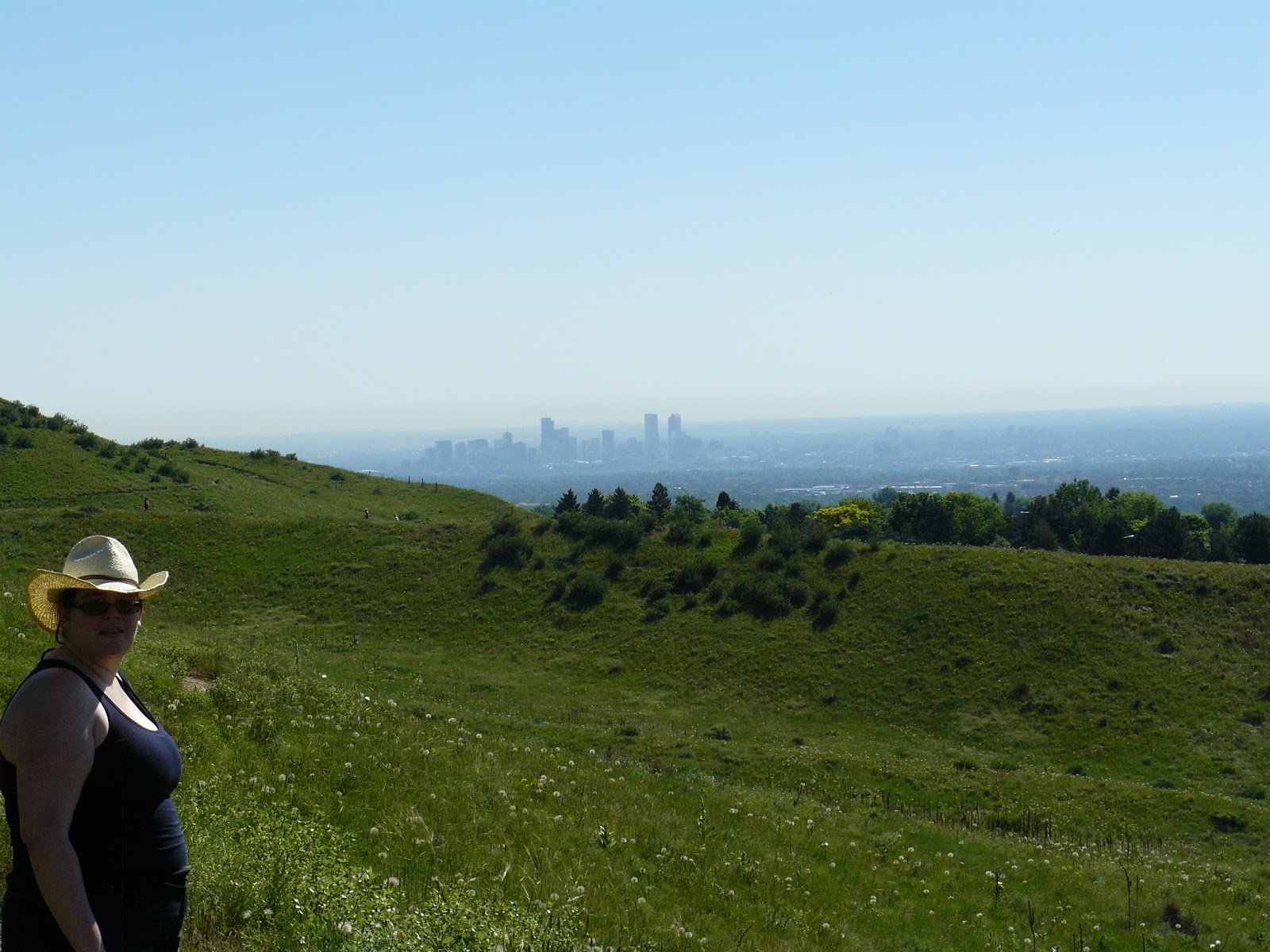
But looking northeast, out across the prairie that day, the haze almost completely obscured Denver.

Weather here is peculiarly local. Looking more to the east, back toward our neighborhood, you can almost see where the haze begins.


          A month after the last snow of the season, wildflowers are peaking on Green Mountain.
                                        Canadian Thistle                                Mariposa Lily  


                                  Orange Paint Brush                               Plains Larkspur

    
                                         Prickly Poppy                                  Saffron Ragwort


Yucca, also called Spanish Bayonet
After an hour on the mountain, I'm ready to head home and get ready for my exercise class. Not only do we have beautiful places to hike, but Lakewood has five rec centers with excellent facilities and staffs. 

           It's good to top the last ridge and be back where we began, Utah Street Trail Head.


Sunday, July 12, 2015

Gone Girl -- A Book Review


This blog post was written July 8 in the foothills of the Front Range of the Rocky Mountains. It should have been hot and dry. It was not. The temperature was 60 degrees and it rained. Not typical Denver-heavy-mist rain, but legitimate drops that made pattering noises on the roof and splashed into the birds’ water bowl.

I should have been working. Novel number two was sitting in my head and languishing on a memory card, waiting for me. There was a piece of short fiction parked on my laptop wanting finishing. I’d committed to writing at least one tweet a day.

And, if that weren’t enough, there was laundry to be done. Instead of doing any of that, I read.

Gone Girl by Gillian Flynn, published June 2012. Wikipedia says it is a “thriller” and “an example of the literary subgenre called Domestic Noir.” A term that was first applied to fiction in 2013 by Julia Crouch, an author described as “the queen of domestic noir.” She defines it as “a broadly feminist view that the domestic sphere is a challenging and sometimes dangerous prospect for its inhabitants.”

The same view of hearth and home held by many street cops, male and female. Retired New York City policeman, Steve Osborne, in his nonfiction TheJob: True Tales from the Life of a New York City Cop, recounts one of many domestic violence cases he's worked. “The wife explained that she was having a heated argument with her beloved, and sisters being sisters – especially in the heat of battle – they stuck together. And when the second woman butted in, the husband went ape shit. . . . he grabbed a large kitchen knife from the sink and carved the two of them up.”

I know I’ve said before that thrillers are not my cup of Earl Grey. And they’re not. Nor do I pay any attention to the New York Times Best Sellers list. But I do take recommendations from friends and family seriously and my daughter said Gone Girl would be interesting to me because of its construction. She was right.

It begins with a husband coming home to discover his wife missing. The story then unfolds alternately, through his viewpoint and the wife’s diary entries. Is she alive? Or dead? Did he do it? If she is alive, how long will she survive?

The plot is exquisitely crafted leaving the reader not knowing what or whom to believe. Twists and turns hardly describe the hairpin curves and backtracks we’re led through. The fear factor, rather than proceeding up and down like a roller coaster, drops us from one frightening crest only a little way down before jerking us to the next greater height. Again and again. Never letting us relax.


I won’t tell you how it ends, but I will say it’ll make you grateful for your own problems.

Friday, July 10, 2015

The Cover Letter


“He’s a nice man,” my husband said.

I know, I thought. I can’t do that. He’s a busy man. Not to mention that I’m more than a little star-struck by him.

“Go ahead. Send him your book. He might like it.”

How cool would that be?!

My chest felt a sudden crushing sensation. You know, like right at the top of the first peak on the roller coaster. The last few seconds before liftoff. That feeling that something awful might happen.

“Write a cover letter and send it to him,” he said.

A cover letter. Of course. I was not at the brink yet. I would compose the perfect cover letter and mail Murder on Ceres to Neil deGrasse Tyson. He’s an astrophysicist. He can see that humanity’s future lies off-Earth. He knows we’ll still be humans and, with or without flying cars, he knows that the future will be normal for those humans who inhabit it. It will be different from today, but it will be just as normal to them as yesterday’s future is normal to us. He’ll get what I tried to do in my
sci-fi/murder mystery.

It could take days. That cover letter. Weeks, maybe.

I began the next day. “Dear Dr. Tyson.” The honorific Dr. is used only for medical doctors except in the South? I’ve been told. And how many times have I been told that all things Southern are somehow less-than? I think of my poetry teacher in college – Dr. Norman Russell, who was a botanist of the first order. A well-respected scientist AND poet who was originally from West Virginia and I’m originally from Oklahoma. Both states are definitely south of New York where Dr. Tyson is from. But Mr. wasn’t right for Dr. Russell and it didn’t feel right for Neil deGrasse Tyson so I kept the honorific.

I then proceeded to write what amounted to little more than a fan letter, telling Dr. Tyson how much I admire him and his work. That I never took issue with his stance on Pluto. That his Cosmos was great and that I was much relieved to hear him say such nice things about Carl Sagan. That I was impressed that he wrote essays for Natural History magazine home of another of my heroes Stephen Jay Gould. That he has a wonderful sense of humor like so many scientists do – Stephen Hawking being an excellent example.

I did show admirable restraint and didn’t mention that I think he’s hot.

I hardly mentioned my book at all.

My editor (who happens to be my daughter) and her friend kindly read my letter and suggested changes.

The letter morphed into a sensible communication that explains a little about Murder on Ceres and why he might enjoy reading it.

Murder on Ceres is an old-fashioned murder mystery set in the future. The story
itself follows intelligent, by-the-book Police Detective Rafael Sirocco, as he tries
to balance the demands of his job and his responsibilities to his family. Through a whirlwind of illicit drugs, space pirates, and secret identities, Rafe chases the truth
all 270,000,000 kilometers from the shining cylinder of Ceres Colony to the alien landscapes of Earth.
And a more reasoned description of my admiration for him.
I appreciate your treating science as “normal” and humanity’s future in Space
as inevitable. I am a great admirer of your work. I think you share my lifelong
passion for space travel and a faith in our future as a species. I hope you enjoy
Murder on Ceres.
Very truly yours,

I signed the letter, ate two left-over muffins, had another cup of coffee, headed to the post office.
I was going to lunch with a friend so I had on make-up and was wearing a dress. Did I mention that I was trembling as I handed THE ENVELOPE to the young woman behind the counter in the post office?
“Have a nice day,” she said.
“You have a nice day, too,” I said.
Then she said, “You look very pretty today. That’s a good color for you.”
Oh, my. Do you think that’s a good omen? Can I be forgiven a small slip of superstition?
I was over the first peak on the roller coaster. Free-falling. Murder on Ceres and its cover letter were away. Flying. That crushing feeling was replaced by exhilaration and I left the post office with one of those nonsensical grins that you just can’t contain.

I did it!