Tuesday, April 29, 2014

X and Y are for X-act-lY a review

     Today is the first day I've written since one week ago yesterday. After a surprise appendectomy late Good Friday, it seemed all was well. And I suppose it was, but Tuesday, a week ago today, things took a turn for the worse and I was back in the hospital with cholitis. Not a good choice. Not a choice at all, really.
     That Tuesday, Wednesday, and most of Thursday, I did nothing but sleep. Then Thursday I opened my reader to Hemingway's A Moveable Feast. I've never been a big fan of his writing style, however this autobiography of his time in Paris in the early 1920s is wonderful. There are still the passages of dialogue full of he-saids and she-saids, but this particular work is filled with the sights and sounds and lives of people in Paris during the post-WWI era.
 
 
Ernest Hemingway and his son Bumby
Paris 1924
 
    In this book I got to see Hemingway as a struggling writer with a young family. During this period he had given up journalism in favor of creative writing. He turned out short stories that were rejected for publication in the United States. In fact, German publications seemed to be his only markets.
     His approach to writing was as intense and focused as a runner training for a marathon. He talks about writing in cafes, describing them as a warm place to work for the cost of a drink. About interacting with the then and now famous literati of the time -- Gertrude Stein, Evan Shipman, Ezra Pound, F. Scott Fitzgerald, Ford Madox Ford, etc. About their petty jealousies and unfounded admirations. About their demands and generosities. About their advice, sometimes accepted. And about their writing, adding to my own list of intended reading.
     And, at the end of the day, he went home to his family.

   
Sylvia Beach in the doorway of her bookshop
Shakespeare and Company
 
     He also wrote of his discoveries, solutions to life problems, the greatest of which was poverty. His accidental discovery of the Shakespeare and Company bookshop made his life and work there possible. Sylvia Beach served as a lending library to those who could not afford to buy books. He paid his minimal membership fee right away but not before she sent him home with volume after volume to read. And he could take the books with him when he and his family traveled. He had to read.
      She also loaned him money when he needed it. Freely. And she reassured him during those times that, like all authors, like all people who set themselves lofty goals, he was good and the world would eventually appreciate his work. After all, didn't the Germans already?
     His descriptions of life in Paris at that time are physical. The light playing across damp faces of  buildings. The goatherd piping his arrival on their street. Milk was delivered on-the-hoof in that pre-refrigeration time. How to travel on foot from where you were to where you wanted to go without passing restaurants and bakeries emitting scents of things a hungry man could not afford to buy.
     And always his main interest was to perfect his writing.  Disdaining unnecessary adjectives and adverbs in favor of the mot juste -- "the one and only correct word to use." 
     To show his characters in their world X-act-lY.


Monday, April 21, 2014

Q is for Quarrel -- Flash Fiction


"Okay. What is it this time? What did I do?"
 
"Nothing. Absolutely nothing."
 
"Then why are you angry?"
 
"Who says I'm angry?"
 
"Is it because I didn't tell you I was going to the party?"
 
"What party? You went to a party? No, really I don't care about that."
 
"Then what? Because I borrowed your new shirt?"
 
"My new shirt? You borrowed my new shirt without asking? Where is it? Is it all right?"
 
"Yes. Yes, of course it's all right. If that's not it, why are you mad at me? Is it because I went with Gary?"
 
"Gary? You said you didn't like Gary. I thought Gary liked me."
 
"I don't know. Maybe he does. You weren't here when he called and we got to talking and . . . . If that's not it, what is it?"
 
"You ate the last piece of Mom's apple pie. I was saving it. You did all this and ate my piece of pie, too. You really are too horrible. I don't know why I have to have a sister anyway."


Sunday, April 20, 2014

P is for Pain or What I did over Easter Weekend

 
Good Friday:
A little before noon. Sick at my stomach.
At noon. Ate two eggs fried in a no stick skillet and two pieces of toast.
At 2:30 got call from my out-of-town husband. Told him I hadn't been feeling well, but felt a little better. He said he was driving to Crossett, Arkansas, and would spend the night with friends. Then go on to Monroe, Louisiana, to catch his flight home Saturday morning.
He had considered staying at his deer camp that night.
I got to feeling worse. Went to bed.
My daughter and her boyfriend came over to do some laundry.
By now I was feeling really uncomfortable. No sharp pains. Too much pressure in my abdomen. I thought I had food poison. And I considered going to the Emergency Room.
My 88-year-old father lives with my husband and me. We have a woman come in Monday through Friday from 8 to noon, but of course we had no plans for anyone to be with him Friday night or Saturday.
It occurred to me that people do die of food poisoning. E. choli, listeria, etc. And then who would take care of my father?
Made the decision to go to the ER. My daughter drove me and her boyfriend stayed with my dad.
I felt bad enough that I didn't take a shower, change out of my robe, or put on shoes instead of my ratty old pink house slippers. I did brush my teeth and my hair.
At the Emergency Room, they collected the normal vital signs, checked my photo i.d., photocopied my insurance card, collect a list of meds I take daily, and ask for my social security number. They ask when did I eat last. How many times have I vomited? Any diarrhea? What did I eat when? By this time I am really not feeling well. They move me into a room.
They hook me up to an IV, take my blood, and everyone who comes into the room wants a list of my daily meds. Somebody already has this information. Leave me alone.
The doctor is not satisfied that my symptoms are consistant with food poisoning, and at my age she is concerned about a heart attack, so she orders an EKG. The EKG shows nothing out of the ordinary.
She orders a CAT scan.
Another doctor comes in and introduces herself as part of my surgical team. Surgical Team? What are we talking about here? Oh, Dr. So-and-So didn't tell you. No. She hasn't been back in yet. Ah, here she is now. Your appendix doesn't look right, she says.
My daughter calls our Home Care Agency to make arrangements for someone to come in the next day for my dad. Saturday. Holiday weekend. But they come through with a man named Richard Something-Japanese. Hmm. Daddy served in the Pacific during WWII. How is this going to go down?
And right behind Dr. So-and-So is another member of my surgical team who pushes my bed and me up to surgery. Or maybe it was down to or over to. I have no idea because I closed my eyes. My daughter stays right with me.
Then a nurse anesthetist is explaining to me the possible negative side effects of general anesthesia. My daughter calls my husband and asks the nurse anesthetist to talk to him. He's a veterinarian. He understands these things. I am so glad he's not staying out at his deer camp. There is no cell reception out there. (What kind of out-back-of-beyond is that that there are no cell phone towers?!) 
Then the surgeon. Again my daughter gets my husband on the phone to talk to the surgeon.
My daughter called my son in Texas to let him know what was going on. She left messages on his voice mail and his wife's. They very wisely silence their phones at night.
Fifteen minutes and I'm in surgery. By now it's 10:30, 11:00 p.m. Surgery lasts about 45 minutes. 
My daughter calls her father and her brother to let them know I'd come through the surgery just fine.
In Recovery for two hours. Only patient in Recovery. Have very pleasant conversation with staff. We talk books, movies. Well, of course we do. The younger staff member didn't know who Lauren Bacall is. Or Humphrey Bogart. In this age of NetFlix and Amazon Prime, how is this possible? It's just as well music didn't come up.
By now I'm feeling MUCH better. And it's up to my room with me and my daughter goes to my house and we both get some sleep.
Saturday is a good day. My daughter brings me my E-reader and my book Murder on Ceres on which I had twenty-nine pages to re-write. I got some breakfast. She got some breakfast and laid down for a nap. My husband called to let me know he was in Monroe and his flight was listed as on-time. I edited the final pages of my book.
My husband calls to tell me he's in Houston in line to board his flight home.
My daughter and I had lunch. And I got home before my husband did. 
Easter morning. I feel great. A little tender, but great.
I put the changes on my book into my lap-top. Saved it to my external hard drive. And saved it to an SD card. Three hundred and fifty-eight pages, 91,668 words, three-years' work. I feel GREAT!
Happy Easter to all!


Thursday, April 17, 2014

N and O are for No.

Thumbnail
 
     No. is the abbreviation for number. Why it is, I do not know. That may be the very least important thing about numbers that I do not know. What I do know is that numbers are a human construct. A construct that comes with rules, dependable rules, logical rules. Even if it sounds illogical to me.
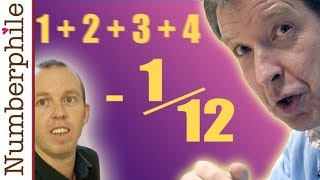
     I just watched a YouTube video http://bit.ly/1neoEKz from  http://www.numberphile.com/ It explains how adding whole numbers from 1 to infinity results in the sum -1/12. That answer sounds like "minus one-twelfth." The man in the video explaining how this can be so is Tony Padilla. (Dr. Padilla, to his students, I'm sure.) And by-the-bye, Dr. Padilla's specialty is physics.
     To add all those numbers and arrive at a minus fraction, he first establishes two other sums, then weaves a bit of arithmetic magic and in the end is the -1/12.
     I watched the demonstration three times before I actually heard him say "you're not measuring physical infinitives in nature." and I remembered that someone once explained to me that mathematics is a language. A language that can be used to describe all kinds of things -- physics, in my opinion being the most remarkable of those things. But since you can't actually add an infinite number of numbers, you must use these other equations to get the answer. Well, of course, you do.
     Which brings to mind the Abbott and Costello routine showing three different ways that
7 X 13 = 28. You can watch them explain on YouTube. http://bit.ly/1r3cXE3 . Their mathematics may be questionable, but it's funny.


Tuesday, April 15, 2014

M is for Moon -- Flash Fiction


gallery photo

“Always we remember your great grandfather. His name was Flying Coyote, and he was a very brave man and a fine leader. You are called Little Coyote because your father loved Flying Coyote and he loves you.”

The old woman stirred the fire and continued her story.

“When he was younger than you he fell from his father’s pony and hurt his leg very bad. It made him sick and the old ones feared to lose him.” She filled the horn spoon and blew softly across the liquid. “Bear With A Sore Tooth sang prayers for him and his old grandmother boiled willow bark and gave him the water to drink as I do you.”

 “It’s not so bad,” he said swallowing. He cuddled the small coyote cub he called Little Brother close to him under the robes.

“I have been told it was this time of year – the time of the Full Pink Moon. The little pink flowers bloomed in the grass and the snow and the sun argued over who would have the land. Some mornings The People would wake to a deep blanket of snow, but by afternoon the sun would have eaten it.”

“Like yesterday?” he asked.

“Yes.” She filled the spoon again. “Like yesterday.”

She and the boy were outside the lodge so the rest of the family could sleep. A full moon hung in the black sky, so bright that only a few stars shone near it. The air was cold and still and fresh, unlike the smoky interior of the tipi.

Little Brother squirmed out of the robes. Little Coyote grabbed the struggling whelp and held him tight by one hind foot.

“No. You must let him go.” The old woman gently opened the boy’s fist.

They watched the cub caper and scamper around them.

“He’ll get cold and come back,” she said. “You’ll see.”

A red shadow began its slow march across the moon, but the boy did not notice. He watched the coyote pup.

“Flying Coyote got weaker and weaker. He did not want to live.” She filled the spoon again and held it to the boy’s lips. “Does your foot still hurt?”

He stretched his leg, testing it. “Not so much.”

“Flying Coyote’s father went out onto the prairie to also pray. He played his prayers on his flute.”

An ember popped out of the fire and Little Brother stopped to sniff it.

“Will it burn him, Grandmother?”

She laughed. “No. His nose can feel the heat. He will be careful.”

She looked up at the moon, slowly being covered with red shadow. Little Coyote followed her gaze.

“What is happening?” he asked in alarm.

“I have seen it before,” she said. “Some stories say that a great mountain lion is eating it.” Seeing his concern, she hurried on. “But I do not think that is what is happening. I have seen this before. More than once.”

He could not take his eyes away from the changing moon.

“Soon the shadow will move on, and you will see your old friend the rabbit on the moon.” She helped Little Brother back under the robes.

Satisfied that his grandmother knew about things like mountain lions eating the moon he asked, “Did Flying Coyote get better?”

“Flying Coyote’s father was playing his flute under a moon just like this one. As the red shadow passed away, a bigger shadow flew across him. It was as big as he could reach with his outstretched arms.” She held out her own arms as far as she could. “And he was a big man.”

Little Coyote’s eyes grew to twice their normal size.

“Flying Coyote's father ducked so hard that the next thing he knew he was on his hands and knees. And something landed on the ground right in front of him. Something dropped from that shadow in the sky. A ball of fur.”

Swallowing hard, Little Coyote held the wiggly cub close under his chin.

“It was like Little Brother – a baby coyote. And its only wound was a broken leg.”

“What did he do with it?”

“The father took it home to his son and told him the Owl Spirit had sent it to him as a gift. And now he must care for the little flying coyote.”

“What happened?”

“Since you’re here, and your father, and your grandfather then of course he got well and that’s how he got his name.”
 

Monday, April 14, 2014

K is for Kindness and L is for Love


     When you've been with someone for a long time, you begin to appreciate Kindness and know Love.
     Passion and Desire no longer color and cover everything. You begin to realize that he's never going to eat spaghetti. And he begins to accept that you are going to be a little late. The truth is no matter what he says or how loud he says it, you're still going to vote for that idiot. And no matter how reasonable you are he's still going to vote for anybody else.
     Then you have a weekend like we just had.
     Tuesday is the deadline for filing income tax returns in the United States, which is where we live. So last Friday, I loaded the software for this year and started ours. He kissed me and left the room. He did not ask what we were having for lunch or when. I guess he fixed his own lunch and ate when he wanted to. He didn't ask about dinner either. In fact, he didn't bother me about anything until after he signed the State Income Tax forms.
     Sunday he discovered that his aquarium had sprung a leak. His big aquarium. The one with the special fish, the particular gravel, the just-so acidic water, special snail shells sans snails, and the little rocks hand-glued to a plastic grid for a background. That one.
     Now my man is a quiet man. Out in public. And most of the time in private. But when things go wrong at home, it's easy to remember that his favorite movie -- well other than The Blues Brothers which he insists is not a musical -- is Christmas Story. And not because he relates with Ralphie, but because he admires the way the father does battle with their furnace and the Bumpus hounds.
     So, understanding the gravity of the aquarium situation, I made a one-time offer of help. He replied, "No." And I left the room.
     I stayed away until he asked me to come see how his second largest aquarium looked with its new residents. And we agreed that it was lucky he hadn't repopulated it. (It's been sitting and bubbling, all the while bereft of fish, for several months now.)
     The moral of this story is that sometimes leaving someone alone is a great Kindness and knowing when to do that is Love.


Saturday, April 12, 2014

J is for Justice


J is for Justice

 Justice is one of those two needs that motivate our highest and our basest behaviors. The other is Safety. Neither is attainable. We can’t give nor get them. Scholars and philosophers have studied and discussed them. Governments and religions have been built around promises of providing them. Tiny humans take up the concepts as soon as they realize that they are separate from the world around them.

Perhaps because Justice and Safety are impossible to have in our everyday lives, we imagine them. We invent stories around them.

The bad guy is identified, stopped, and punished. Safety is restored and Justice is served. There is nothing so dissatisfying as a murder mystery that goes unsolved or a villain who goes unpunished.

It happens all the time in real life and we still stop what we’re doing to watch our daily dose of news about the O.J. Simpsons and the Oscar Pistoriuses of the world on trial. We weren’t there. We can’t know what really happened or who did what or why. We hear too many possibilities – the prosecution’s story, the defense’s story.

These events underscore the perception that Justice is not only blind, but she’s lame. She staggers and stumbles along like Shakespeare’s Richard III, Cheated of feature by dissembling nature, Deform’d, unfinish’d, scarce half made up. The difference in Justice in the real world and Justice in Shakespeare’s fictional world is that Shakespeare could establish without a reasonable doubt what the crime was, who the criminal was, exact the appropriate punishment, and reassure the realm of a time to come with smooth-fac’d peace, With smiling plenty, and fair prosperous days!

Since I have to live a real life, I am thankful for the fiction writers who give me moments and hours of respite in the imagined world of Justice and Safety.